DUMFRIES, Va.—After nearly eight months on the road, we spent a few days at our home base of Northern Virginia this week, closing a grand loop we traveled around the United States that you can see on the map below. Our journey began when we left the area on Feb. 9 and covered 10,500 miles towing the travel trailer, 63 campgrounds, 24 states, 22 national parks, and reunions with family and friends from California to Michigan.

We survived challenges along the way, as I described in this post in August, but on the whole our adventure has been a great success. It’s allowed us to see places and people we would probably not get to see if we had needed to book a regular kind of vacation, with flights, hotels, and rental cars.
Among the more memorable moments for me were wading up the Rio Grande River through the Santa Elena Canyon in Big Bend National Park, hiking to the top of Yosemite Valley, stalking wild bison in Yellowstone and the Dakotas, and swimming in the blue expanse of Lake Superior. (I’ll write a separate post soon rating the national parks we visited.) As for family, we saw all three of our children, siblings, nephews, a niece, and all 14 of my late mom and dad’s great grandchildren (in order of our visits: Davis, Mae, Max, Clara, Aben, Owen, Gabriella, Grace, Milo, Alina, Evvie, Elise, Finn, and Ford).
We’ve interacted with all kinds of people in the campgrounds where we’ve stayed. People in RV parks are almost always friendly and represent a cross-section of Americans. The most well represented groups are middle-class retirees like us, followed by parents on vacation with their kids (mostly during the summer), and people living in their RVs as they try to get established. In Lemon Cove, CA, our neighbor Brian and his family were living in an RV they bought and had towed to the site while they looked for permanent housing and a truck that could pull the RV. In Colorado Springs, CO, David and his family were living in the RV next door while they looked for a home they could afford. (See my July review of the book and movie “Nomadland” for more on this phenomenon.) The oldest RVer we met was a 98-year-old man at the campground near Yosemite who was still towing a fifth-wheel (with his daughter and son-in-law accompanying him in their small motor home).
We have our challenges as a nation, but I can report from spending most of 2021 traveling from one end of this country to the other and back that large swaths of America remain peaceful, prosperous, and friendly. The towns we stayed in and passed through weren’t so much divided by rich and poor as by those that are thriving and those that are just hanging on or slowly fading. Such places as Red Lodge, MT, Cody WY, Port Angeles WA, Placerville CA, are not enclaves for the rich, but they are prospering towns with well-kept businesses and neighborhoods. We also drove through small towns that were marked with boarded up storefronts and an older stock of houses. The roads and bridges that carried us on our way were generally in good shape, contrary to the claims of “crumbling infrastructure.”
Traveling by RV is a great way to see the country but it also has its limitations. It’s an ideal way to visit friends and family, allowing us to see them without asking for a place to stay. We can also host people for a cookout or time around the campfire. It’s more like being their temporary neighbors than houseguests. For a longer trip, traveling by RV saved us from expenses for flights, rental cars, hotels, and eating out for just about every meal. It’s a minor miracle that we can drive down the road 200 miles to a completely new place and still inhabit our 227-square-foot efficiency apartment with all our familiar stuff.
One limitation of RV travel is flexibility. It’s much more difficult to stray from the path between destinations to visit some interesting site. Somebody called it the “hub and spoke” approach to travel: We travel straight to our next campground destination, and then unhitch the truck to explore what we can from our new base camp. That means if there’s an interesting spot halfway between two campgrounds, we might need to drive 100 miles or more each way to reach that spot. It means we’ve missed a few tourist sites that we could have more easily bagged if we had just been driving a car.
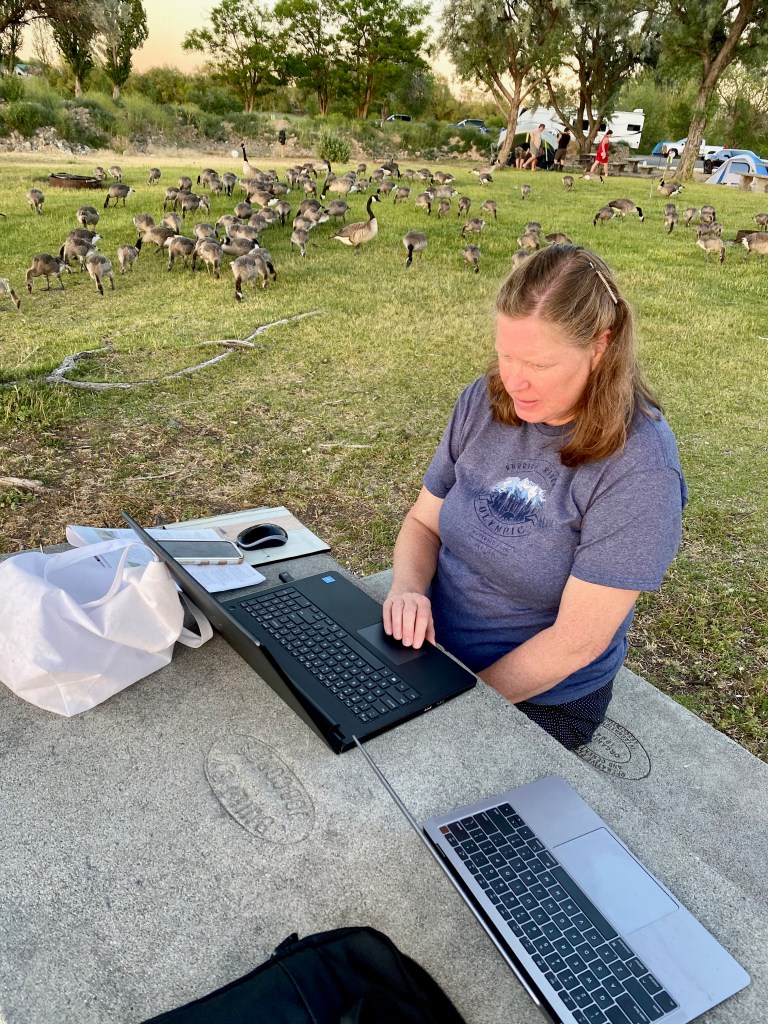
Another running issue in an RV is connectivity. Many of the places we stayed at were in beautiful natural surroundings but far from an urban area with a cellular signal. Campground wi-fi is notoriously spotty. One place told us, “Remember, this is country wi-fi,” meaning the signal was weak and prone to be overloaded. Some parks specifically prohibited streaming. We paid Verizon for a “jet pack” that converts the local cell signal into a wi-fi hotspot in our camper. But we also pay extra for the data we stream through it, which is limited and good for three or four movies at most before the monthly data allotment is used up. Often our best connection is using our iPhones as hotspots, but the data is limited there, too. As a result, we were forced in some places to travel to hill tops or parks in town to get a decent signal. (Here’s a photo I posted back in June of Elizabeth filing the church prayer list from a park in Coulee City, WA.)
Yet another challenge has been finding Christian fellowship. In our entire time on the road, we made a point not to travel on Sundays so that we could find a place to worship with other believers and rest from our regular duties. We looked for reformed Presbyterian churches when nearby, but we also saw this as an opportunity to experience how other Christians worship on Sundays. We’ve been to Baptist and Lutheran churches, a big, contemporary non-denominational church, and a “cowboy church” (in Texas, of course!). We’ve missed the regular fellowship and accountability of the local church, but in every one of the places of worship we visited, the people were welcoming and the gospel was preached.
Life on the road can also be an interior journey. I’ve learned more about myself, on the upside as well as the downside. Without any prior training, I found out I can hitch, tow and back a 7,000-pound trailer and fix quite a few problems myself as they come up. Elizabeth and I have also learned more about working together as a couple. (Guys, it’s a beautiful sight to see your spouse wielding a rubber mallet to pound an iron bar into submission.) But living in a confined space also limits the opportunities to go off and do things on your own. I’ve had to learn a few lessons on this trip about holding my tongue more often, conceding the last word in a discussion, and being content to let things work themselves out.
Being retired from any paid work, I’ve also had more time to read in the RV. Since we set sail in February, I’ve read about 20 books, mostly on history, but also about science and geology. It’s a wonderful fact that when you’ve lost yourself in a book, it doesn’t matter if your easy chair is in an RV or a mansion. I’ve had the pleasure of reading about the naturalist John Muir while we explored the places he loved, and most recently about Theodore Roosevelt’s “mornings on horseback” with our memories still fresh from our time in the Badlands of North Dakota.
Elizabeth and I are both grateful to God for this opportunity to see all these places in the United States that are so full of history and beauty. And we’re thankful that over these almost eight months and more than 10,000 miles that we’ve been spared any accidents or major problems with the rig. And we’re thankful for the great time we’ve had as temporary neighbors to the family and friends we’ve been able to visit.
***
Although we’ve completed the loop, our journey continues. We left our base in Northern Virginia yesterday to spend a few days at a campground near the beach in Rodanthe on the Outer Banks of North Carolina. Over the next few weeks we’ll continue to travel south along the coast, enjoying the sights and the relatively warmer weather until we return to our home in Vienna toward the end of the year. In the meantime, you can pray we won’t need to ride out any hurricanes in the RV!

 Daniel Griswold's Blog
You skipped new York and new England. I also recommend the Canadian maritimes.
Those worthy destinations will need to wait for a later trip, Lord willing. And because of COVID, Canada was closed for most of our trip. We could only cover so much ground in eight months.
Sounds like a great trip. One thing for certain is you got the last two words in when you two had a little quarrel. YES DEAR
Good advice!
Have you passed by any bookstores on the way and bought some books recently, Mr Griswold?
We like to stop in bookstores and we do occasionally buy books. Our storage space is limited, so we don’t buy very many. I’m planning a post soon on my top book recommendations. Stay tuned!