Elizabeth and I recently watched the Oscar-winning movie “Nomadland” from an appropriate venue—inside our 30-foot travel trailer RV at a campground somewhere out West on our journey across the United States. The movie and the 2017 book of the same title tell the story of people living on the margins of society in aging vans, trailers and motorhomes trying to survive in modern America.
We both read the book beforehand and both agree that this is an unusual case where the movie is superior to the book it’s based on. The movie is not a classic, but well worth watching. Although the book is non-fiction, the movie follows the fictional character Fern as she interacts with the actual people profiled in the book, who are all traveling the American west seeking work and an affordable place each night to park their modest homes on wheels. (Like us, the nomads are “not homeless, just houseless.”)

What resonated from the movie was the beautiful cinematography of the western landscapes and the music that accompanied it. Like the Griswolds, Fern enjoys the California redwoods, the Arizona desert, mountain campgrounds, and even a dip in a mountain spring. People on the road were portrayed as friendly and helpful, just as we’ve experienced during our five months of traveling in an RV. We’ve seen these older RVs parked in campgrounds, on roadsides, under bridges, and on public lands during our travels.
The movie offers a sympathetic and fair view of the “nomads” at work. Fern and her fellow travelers manage to find employment at Wall Drug in South Dakota, in the Red River Valley sugar beet fields, and in seasonal jobs at a giant Amazon fulfillment center. The work can be demanding, but it offers the income and flexibility that seem to fit with their lifestyle. The nomad guru Bob Wells does express his disapproval of the American economic system, but such pronouncements are few in the movie.
Alas, the book is a mixture of good journalism and left-leaning ideology. Author Jessica Bruder faithfully chronicles the daily lives and struggles of the nomads. She even lives herself for a time among the nomads and works at some of the places that hire them. The biggest problem I had with the book was the author’s ideological inclination to generalize the plight of the nomads as a broader indictment of the American capitalist system.
Bruder quotes Bob Wells approvingly as saying the U.S. economy is like the sinking Titanic. The nomads have come to realize that chasing the American dream of a house and kids and career is nothing but a big con. The author cites debatable statistics that the American middle class is disappearing and that real wages haven’t budged in decades for half the American workforce. A central theme of the book is that the 2008-09 recession forced large numbers of people into nomadland by wiping out their retirement savings and forcing their homes into foreclosure.
While the stories the author tells are real and painful for those affected, they are not all that typical. As deep as the recession was, the stock market began recovering in March 2009 and within a few years it had recouped its losses from the recession. Housing prices recovered more slowly, but they too have been rising steadily for the past decade. A veteran financial advisor I know told me in an email that the nomads who lost all their savings in the 2008-09 recession (or the 2001-02 dot-com recession before that) are a special case:
The reality is that only two groups of investors were really wiped out during either of those downturns. The first were folks who had a massive amount of their investment in a single company. … The other group of people who were seriously hurt are the folks who couldn’t stomach the downturn and got out of the market. Inevitably when people panic and get out, it is usually too late to avoid most of the downturn but more importantly people are almost always too slow getting back into the market.
(Please see the excerpt below from his email for more detail.)
The book also paints a harsh picture of Amazon fulfillment centers. The company actively recruits what it calls “CamperForce” workers for seasonal employment in its warehouses, even arranging camping areas nearby for their RVs. The Nomadland author puts a negative spin on the arrangement, describing how many retirement-age nomads work shifts of 10 hours, walking 15 miles on concrete floors, stooping, squatting, and climbing stairs, all to enable the company to meet the holiday rush. She describes the Amazon encampments as “more like microcosms of a national catastrophe.”
The book misses the mutual benefits the arrangement offers to both Amazon and the nomadland workers. The work is hard, but competitively compensated. The workers enjoy comradery in the campground as well as the company lunchroom. The work fits their nomadic lifestyle while supplying needed seasonal labor for the company. The movie shows a much more benign and accurate picture of the Amazon experience than the book.
A big irony of Nomadland is that just about the time the book came out, in 2017, the American labor market was shifting into high gear, with the unemployment rate dropping below 4 percent and wage gains accelerating up and down the income scale. The book is more descriptive of Obama’s America than Trump’s America (pre-COVID). While the left-leaning author would be loathe to admit it, her critique of the American economic system as being rigged against the middle and working classes echoes a major theme of Donald Trump’s campaign in 2016—a theme that I’ve questioned in previous writings.
From our current vantage point, Elizabeth and I probably see more of these folks than does the average American. We sometimes meet them casually in the RV parks where we’re staying, or we see their typically beat up RVs parked along the wayside without any hookups for electricity, water, or sewer. (See photos below.) Unlike the nomads, we don’t need to worry about earning income for food and gas. As the Nomadland author writes, we’re among the “… retirees tootling idly around America, sightseeing and enjoying the relaxation they earned after decades of employment. RV, after all, stands for recreational vehicle.”
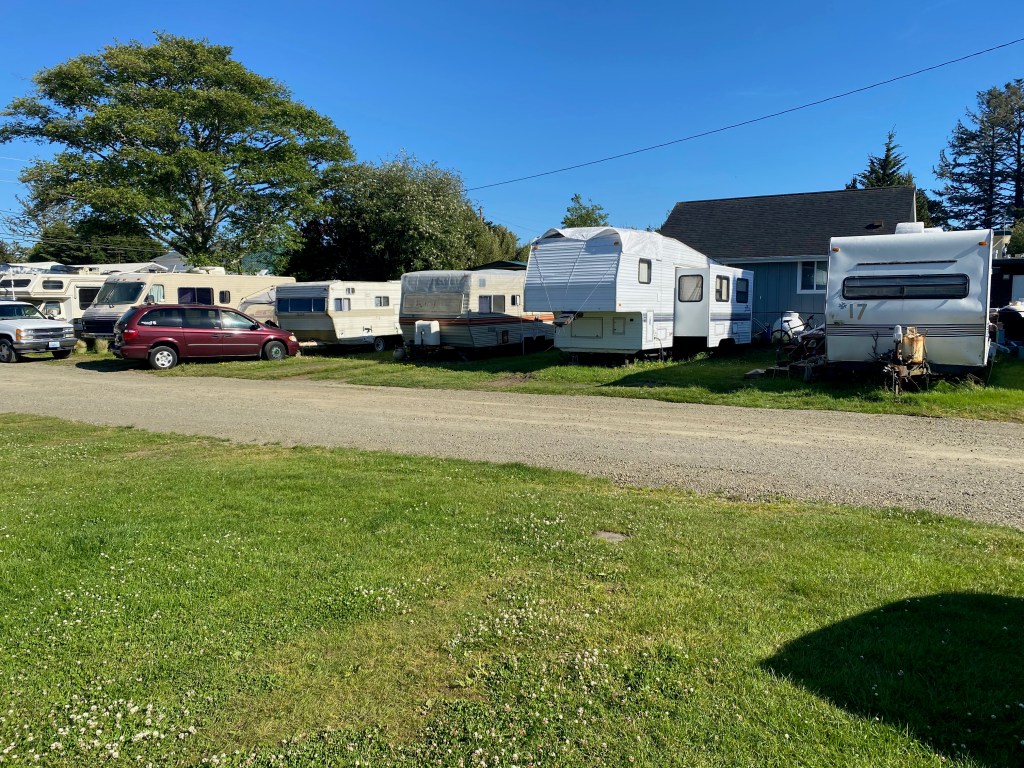
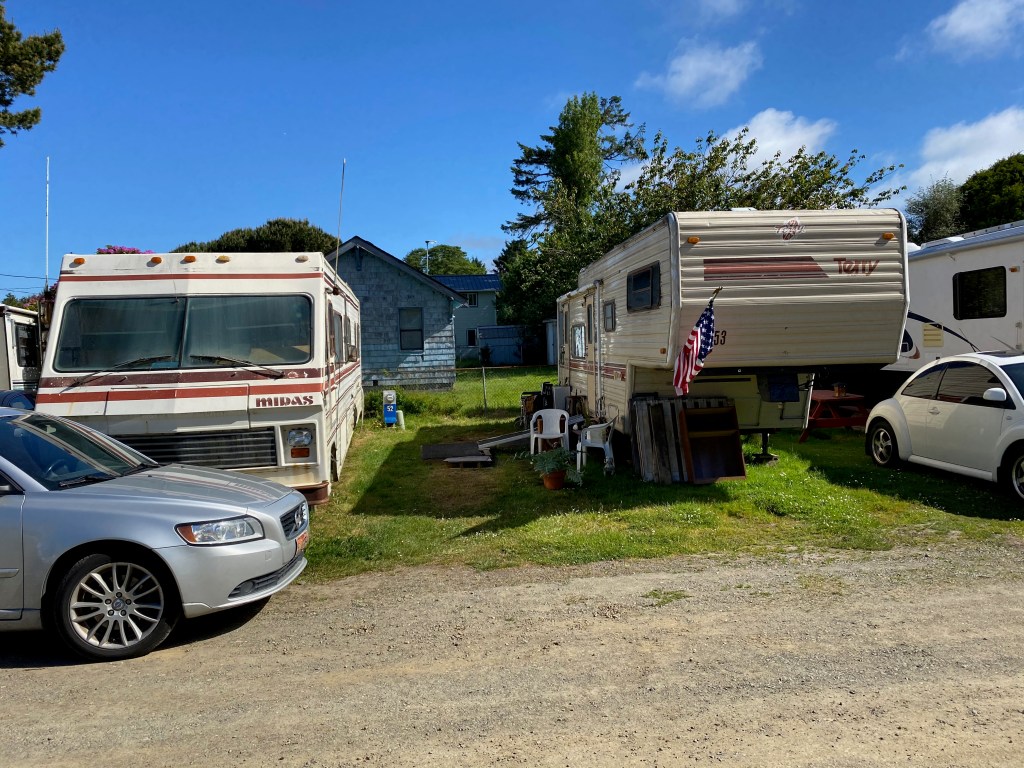
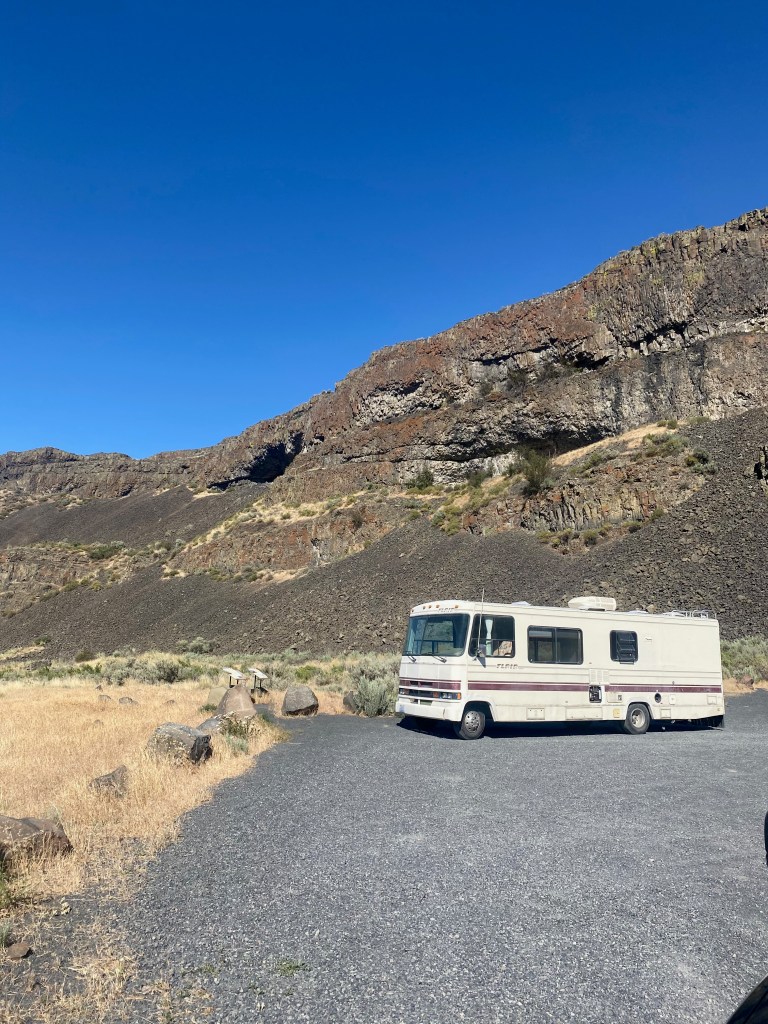
None of this means we should be unsympathetic to the people living on the margins in their RVs. People fall on hard times for all sorts of reasons, including addiction, mental health issues, bad financial decisions, family breakup, hard upbringings, and simple bad luck. It does mean we should be cautious about reading too much into the phenomenon. No matter what the current economic conditions, the people of nomadland will always be among us.
***
A financial adviser’s view of the impact of the Great Recession of 2008-09 on the personal savings of Americans:
“I haven’t read (or seen the movie) Nomadland but I am generally familiar with the storyline. In general, the 2008-2009 recession/financial crisis did do a lot of damage to many people’s portfolio. The reality though is that being “wiped out” means very different things to different people. For many people having an $800k portfolio cut in half and losing $400k would be considered being wiped out by the downturn and that was very common if someone was invested 100% in stocks (as it was in 2000-2001 during the dot-com crash). Behavioral finance research tells us that folks are much more bothered by losses than they are made happy by gains. You definitely see that in the market where people view a 50% downturn in the market as a once in a lifetime crisis event, but see 15% – 20% annual gains for three years in a row as the normal condition. In fact, both of those are historically normal, but not consistent, events for the stock market.
“The reality is that only two groups of investors were really wiped out during either of those downturns. The first were folks who had a massive amount of their investment in a single company. This happened to a good number of people either through chasing a single hot investment (think Enron or Worldcom or pets.com in the 2000 timeframe or collateralized mortgage obligations in 2008) or by 401k investors who had a significant portion of their portfolio in their own company stock (many companies would provide the entire match in company stock and people were slow to diversify – Wachovia bank comes to mind).
“The other group of people who were seriously hurt are the folks who couldn’t stomach the downturn and got out of the market. Inevitably when people panic and get out it is usually too late to avoid most of the downturn but more importantly people are almost always too slow getting back into the market. For people that bailed out in 2009, if they couldn’t bring themselves to get back into the market until 2012 or 2013 then they missed out on a huge recovery of the market. The same thing happened last year. Really the only folks hurt by the pandemic market downturn were folks who panicked and sold their holdings in March and then waited until July or August to get back in.
“In my mind, what was really extra bad about 2008-2009 was a combination of demographic and emotional factors. With the bulk of the baby-boom generation getting close to (or at least beginning to consider) retirement, much of that temporarily lost wealth had the effect of changing minds about short to medium term plans which resulted in more panic behavior. Also, the slow gradual recovery from that recession didn’t allow people to feel the exuberance that normally comes with a typical more rapid recovery which delayed (or in some cases permanently stopped) the return to investing in the stock market. It isn’t unlike the lifelong frugality that many of our parents adopted as a result of living through the extended Great Depression.”

 Daniel Griswold's Blog
Portfolios? Portfolios? A poor person’s “portfolio” consists of a little equity in a tract house, a pension plan, and the few nice durable things he bought when times were better. The recession, over seas movement of jobs, technological changes that outpace people’s ability to adapt, and plain misfortune, affected the “nomads” in ways the “investor class” never experienced.
Lyle– I agree that “portfolio” has a profoundly different meaning for lower-income people than for those with higher incomes. The book talks a lot about people who were in the higher income brackets before the Great Recession wiped out their lifetime savings. My point in the essay is that such catastrophic losses were a special case, for reasons the financial advisor outlined. If a person’s retirement savings were broadly invested in the market before the recession, and they didn’t sell in a panic when the market tanked, their portfolio would have recovered in a few years, as it did for most Americans households. As for the other factors you mentioned, I’ll just say that there are differing views on the impact of trade and technology on jobs. (For a deeper dive on that subject, see the link below to a 2020 paper I wrote for the Mercatus Center.) The reality is that, before COVID, the US job market was strong, with low unemployment and rising real wages. There were lots of jobs available for our friends in Nomadland. Thanks again for your thoughtful comments!
https://www.mercatus.org/publications/trade-and-immigration/fail-or-flourish-american-workers-globalization-and-automation