Most of my time working in Washington has been devoted to helping my fellow Americans understand the many benefits of keeping the U.S. economy open to the world. That includes openness to trade, international investment, and legal immigration. With a long paper trail of articles, talks, and studies, it should be plain that I don’t support much of what the new Trump administration is trying to implement on trade.
In fact, I wrote three studies or essays in recent years that speak directly to what I would argue are President Trump’s misguided policies on trade. One challenges the president’s idea of imposing “reciprocal tariffs” on U.S. trading partners. In early April, the president is expected to announce plans to raise U.S. tariffs to match those imposed by other countries on what we export. In short, he wants the United States to raise its tariffs on specific goods to match the tariffs that other countries impose on those same goods exported from the United States. For example, if a trading partner imposes a 10 percent tariff on U.S. automobiles (as the European Union does), then the United States will raise its tariff on automobiles imported from that trading partner to 10 percent, up from the 2.5 percent we normally impose.
“Reciprocal tariffs” may sound fair, but if implemented the president’s idea would cost Americans dearly in higher prices for consumer goods, lost export opportunities for producers, and a weaker overall economy. In a 2019 study for the Mercatus Center, “Mirror, Mirror, on the Wall: The Danger of Imposing ‘Reciprocal’ Tariff Rates,” I found that implementing reciprocal tariffs against our ten largest trading partners would boomerang back to damage American producers and households. As the abstract of the study states,
Applying reciprocal rates would exponentially complicate the US tariff code, lead to higher duties on a range of imports important to US consumers and producers, and invite retaliation from major trading partners. Specifically, if applied to the United States’ top 10 MFN trading partners, reciprocal tariffs would result in a nearly 10-fold increase in the number of duty lines in the US tariff code. The average US duty on imports from those nations would more than double, from 2.1 to 5.4 percent. Imposing reciprocal duties would ultimately threaten to unravel a postwar global trading system that has reduced tariffs worldwide while protecting US exporters from discrimination.
A more recent essay I wrote for the Cato Institute argues that free trade agreements the United States has signed in recent decades have been good for America’s productive capacity and the living standards of American workers while enhancing our influence around the globe. The August 2024 essay was titled, “How Trade Agreements Have Enhanced the Freedom and Prosperity of Americans,” and was co-written with Clark Packard. The essay provides an antidote to criticism of such trade pacts as the North American Free Trade Agreement with Canada and Mexico and the multilateral agreement among the more than 160 members of the World Trade Organization.
And finally, to the argument that those trade agreements have caused a decline in living standards for American workers, I showed in a September 2023 essay for Cato that the opposite is true. The average American worker is better off today that 50 years ago by a range of measures, and one of the main reasons is an expanding economy driven by globalization. You can read the essay, “The Misplaced Nostalgia for a Less Globalized Past: The ‘Great Again’ Economy Wasn’t so Great,” at Cato’s “Defending Globalization” website.
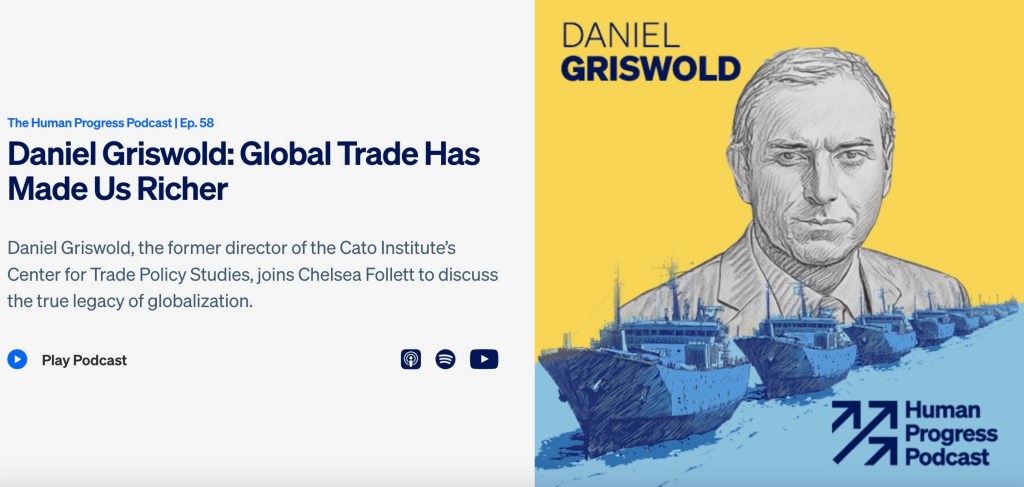
You can hear me talk about both of the Cato essays in a just-released podcast, “Global Trade Has Made Us Richer,” hosted by Chelsea Follett of the institute’s Human Progress project. The podcast provides an important fact-check of all the negative things President Trump has been saying about trade agreements and their impact on American workers.
The bottom line in all three of these works is that it is protectionism and higher tariffs that threaten the well-being of American workers, not our freedom to trade with the rest of the world.

 Daniel Griswold's Blog
Thanks for the sharing, Sir!
In broad terms I have always supported free trade and presidents from both parties have also supported it for decades. In the “old” days Republicans were a bit better at free trade than Democrats, because unions, at times, have favored protectionism. I believe that in the long run free trade encourages world peace because you are somewhat less likely to go to war with trading partners. Today, Republicans have forgotten why we dumped the tea into the harbor. You don’t need a doctorate in economics to see tariffs will cost American consumers money. In the process we will make a dangerous world a bit more dangerous. Republicans are being foolish and reckless. —- Barry Noreen
Well said, Barry! I could not agree more.