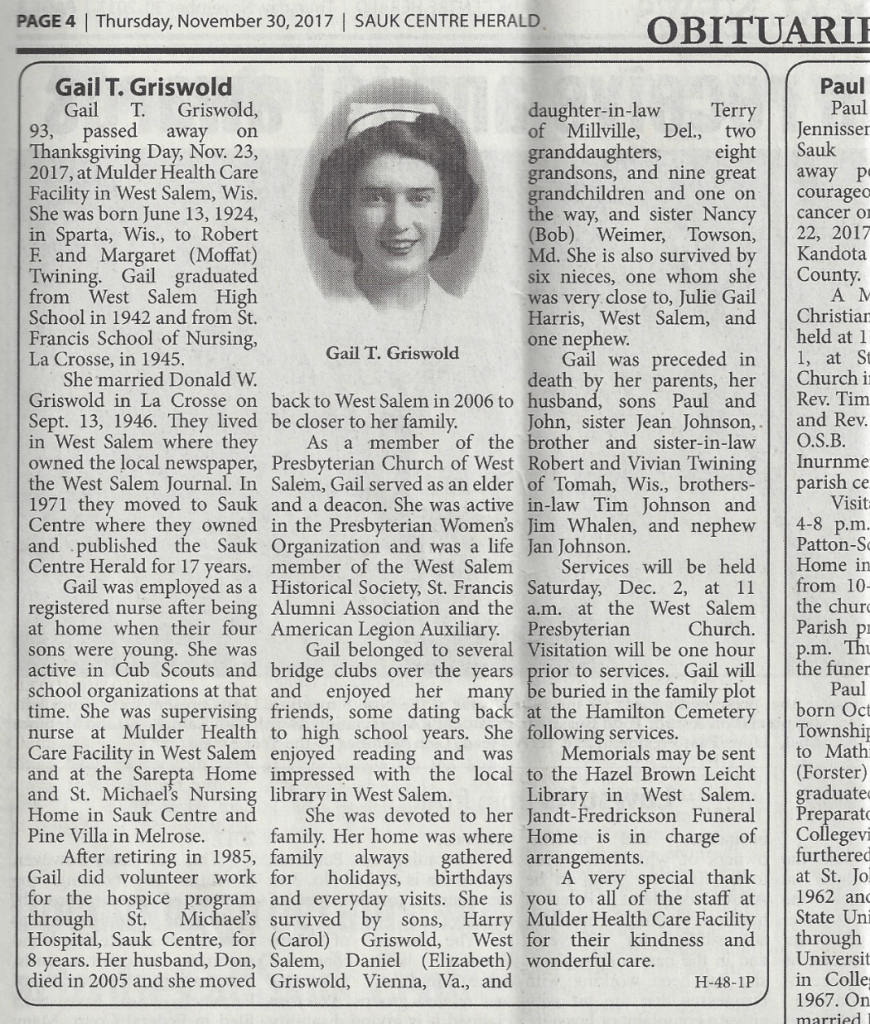
Today would be my mother’s 100th birthday. Gail Griswold was born on June 13, 1924, in Sparta, WI, and she passed away on Thanksgiving Day, November 23, 2017, in West Salem, WI, age 93. She lived a life full of friendships, love of family, and service to her church and neighbors.
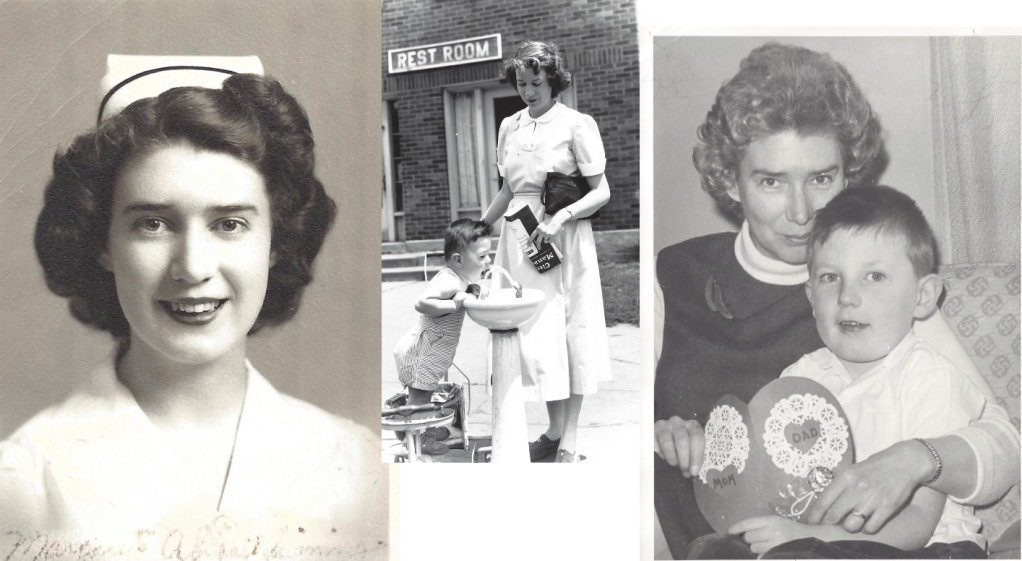
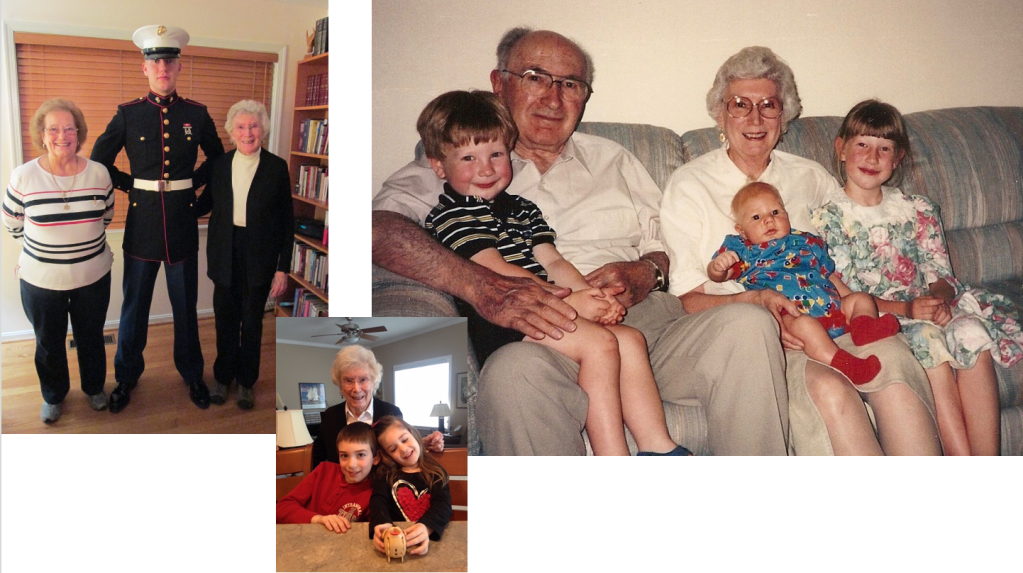
She and my Dad, Donald Griswold, were good parents and set an example for our entire extended family. They were truly part of “the Greatest Generation.” Among their legacies are three granddaughters, eight grandsons and 16 great grandchildren!
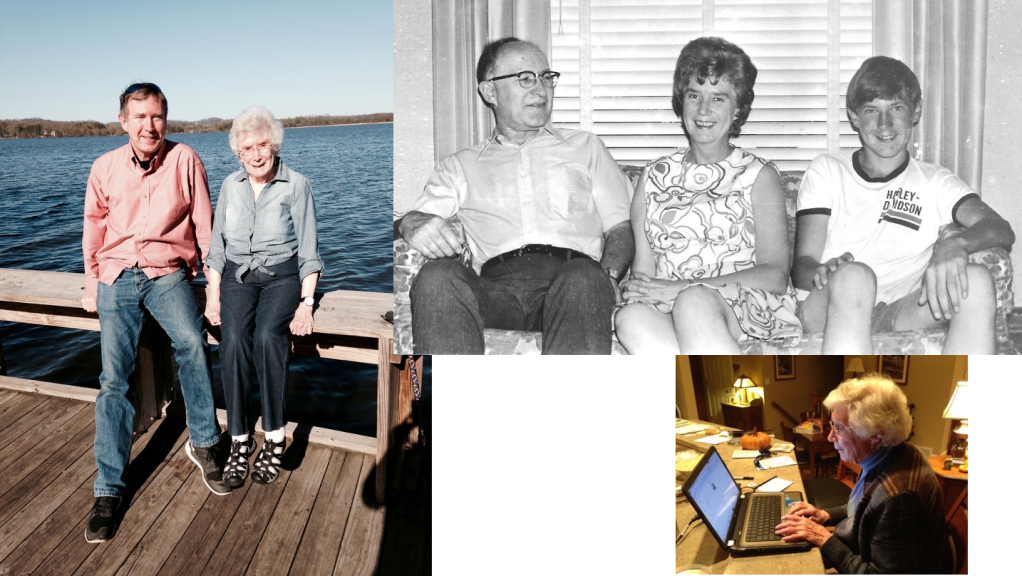
In honor of Mom, I’m posting favorite photos, the eulogy I gave at her funeral, an obituary from the Sauk Centre Herald, and a bonus anecdote about my Mom’s one shining moment in cribbage.
***
Eulogy for Gail Griswold, West Salem Presbyterian Church, December 2, 2017, delivered by her son, Daniel Griswold:
Gail was the best mom, the best wife, the best sister, the best aunt, the best grandmother, and the best great grandmother.
Mom came from a humble background, but despite that or maybe because of that she appreciated the finer things in life. She was always well dressed and she kept a beautiful and hospitable home. She exposed me to things that I wouldn’t have naturally gravitated toward such as Russian literature and classical music.
She and Dad supported my education through college and graduate school. She gave us cars and furniture. I was always kind of afraid to mention a need to Mom because she would want to give us what she had.
She was a faithful wife to our dad. She cared for him in his final years and gave him the best home health care a man could have. As my dad said, she was his “phantom of delight.”
Mom gave us a great example of Christian service and humility. She served people through her work at the church, the nursing home, and as a hospice volunteer.
When I was a kid there were days when I would come home from the old West Salem Elementary School to our house on Youlon Street to find a young handicapped woman named Judy Berra sitting on our living room floor. Judy had a severe disability and was a resident at Mulder Nursing Home where Mom worked. Mom would bring her home so she could enjoy a few hours in a family home. She adored my mom. I’m told that Judy would be seen sitting on the floor at the nurses’ station hanging on my mom’s skirt.
Mom’s home was always our home whenever we had family gatherings. I know I speak for Harry when I say how much we enjoyed our gatherings in the summer at a cottage on Fairy Lake outside Sauk Centre, Minnesota. Like so many good things in life, it all happened kind of by accident.
Mom and Dad and I first rented the cottage when we moved from West Salem to Sauk Centre in the summer of 1971 because the house my parents bought wasn’t ready to move into yet. Mom and Dad rented the cottage every summer after that for 17 years.
We had such good times there with Mom and Dad and our kids. My family would stay in town at Mom and Dad’s, Harry’s family would stay out at the cottage, and John’s family in a local hotel. My dad, always setting a good example of the protestant work ethic, would never come out until 5 p.m. after he’d put in a full day at the newspaper.
Mom was so competent and capable for her entire life up until the last year and a half or so that it was sometimes hard for her to accept not always being able to remember what she wanted to. A couple of years ago we were talking on the phone and she was trying to remember something about me and was getting things confused with my three older brothers.
She said, “Sometimes I think I had one kid too many.”
I said, “Mom, I wouldn’t put it quite like that!”
My Mom was a faithful Christian woman. She read the Bible and prayed and served the church her entire adult life.
There are two passages in the Bible that whenever I read them I think of our dear mother. In Matthew 25, Jesus tells the parable of the talents. The point of the story is not who has the most talents, but who makes the most of the talents their master has given them.
Mom was a woman of ability and accomplishment, but she had to overcome a childhood that was poor even by the standards of the Great Depression. My mom took those talents God gave her and made the most of them. She worked to put herself through nursing school during the war. She and dad created a loving, stable, middle-class home for us four boys.
In the parable of the talents, the master calls on his servant who was given two talents to give an account of what they had done with what God had given them:
And the servant also who had the two talents came forward, saying, ‘Master, you delivered to me two talents; here, I have made two talents more.’ The master said to the servant, ‘Well done, good and faithful servant. You have been faithful over a little; I will set you over much. Enter into the joy of your master.’
The other passage that always makes me think of Mom is Psalm 23. She told me when I was a kid that she loved that Psalm because of the beautiful language, especially the King James Version. It’s also a fitting psalm for my mother’s life–for the challenges she faced, the trust she put in God, and her hope in the life to come.
The Lord is my shepherd;
I shall not want.
He maketh me to lie down in green pastures;
He leadeth me beside the still waters.
He restoreth my soul;
He leadeth me in the paths of righteousness
For His name’s sake.Yea, though I walk through the valley of the shadow of death,
I will fear no evil;
For Thou art with me;
Thy rod and Thy staff, they comfort me.Thou preparest a table before me in the presence of my enemies;
Thou anoint my head with oil;
My cup runs over.
Surely goodness and mercy shall follow me
All the days of my life;
And I will dwell in the house of the Lord Forever.
We love you, Mom. Enjoy your eternal reward in the house of the Lord.
***
***
Mom grew up playing cribbage with her father, my Grandpa Twining. And at some point in my childhood she passed along the rules of the game. We would usually play a few games whenever I came home to visit.
If you’ve never played cribbage, it’s a card game where you keep score by moving pegs along a board. The boards can come in all sorts of styles, but they all have 60 or 120 holes per player. The winner is the first person to cross the finish line at 120 points. A typical hand will score four to eight points, and anything over 20 is worth celebrating.
Mom told me that in one game with her own dad, when she was probably a teen-ager, she scored a 29– the absolute top score possible in cribbage and a very rare hand. According to Google, in the two-person games we typically play, “The odds of getting a perfect 29 hand in cribbage are 1 in 216,580…” * Mom said that her dad was so excited about her feat that he told everybody in town. Spreading of the news probably started downtown in Krome’s Bar.
As a postscript, I sometimes play cribbage with my kids when they visit. When my daughter Emily and I played in March, we used the well-worn board my mother passed along to me. I can’t remember if she told me for sure, but I like to think it’s the board on which she counted off her legendary 29!
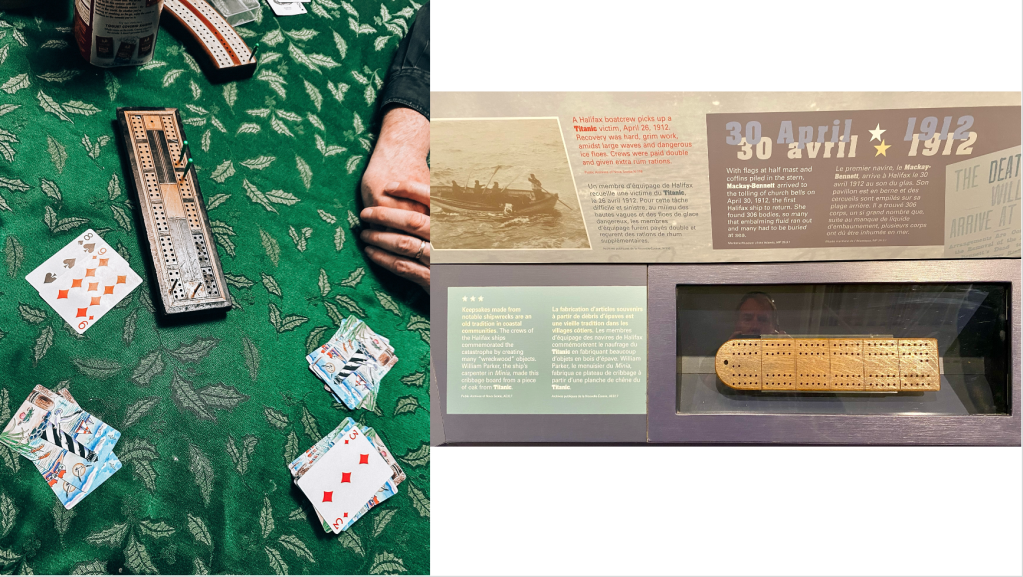
Left: Emily and I playing cribbage in March on my Mom’s old board. Right: A cribbage board Elizabeth and I saw in September 2022 at the Maritime Museum in Halifax, Nova Scotia. It was fashioned by a ship’s carpenter from a piece of oak from the Titanic.
* Again, from a website turned up by Google: “A perfect hand is 29 points, and it happens when a player holds three fives and a jack, then obtains the other five when the “cut” card is turned over. The final five must be the same suit as the jack.”
 Daniel Griswold's Blog