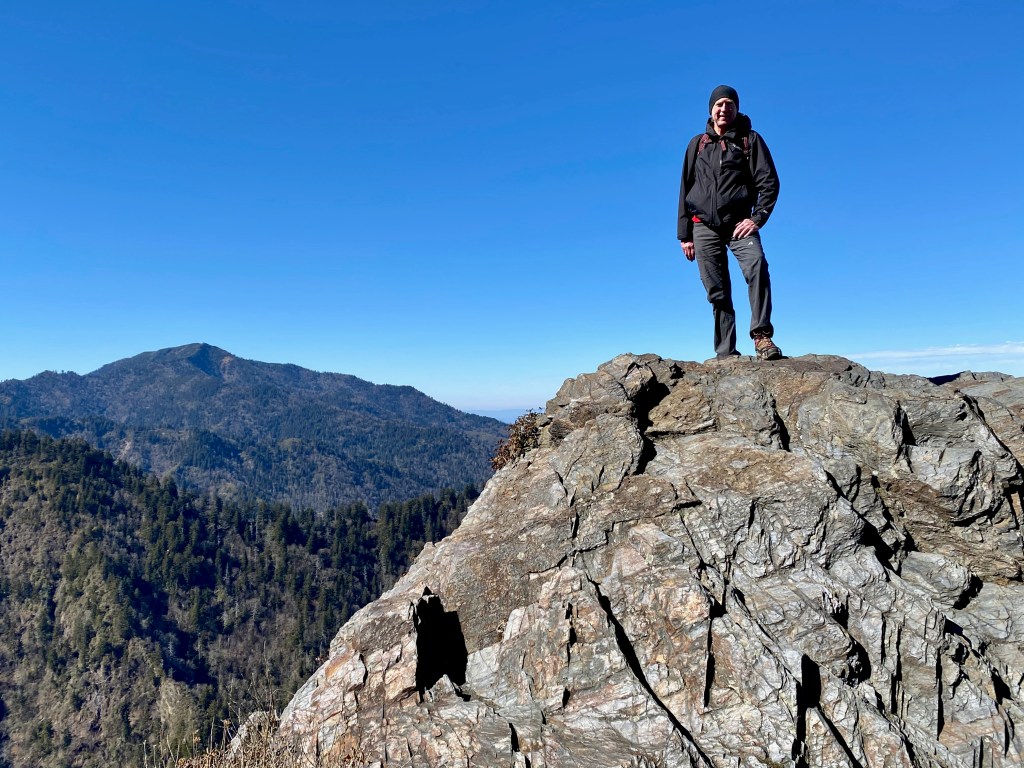
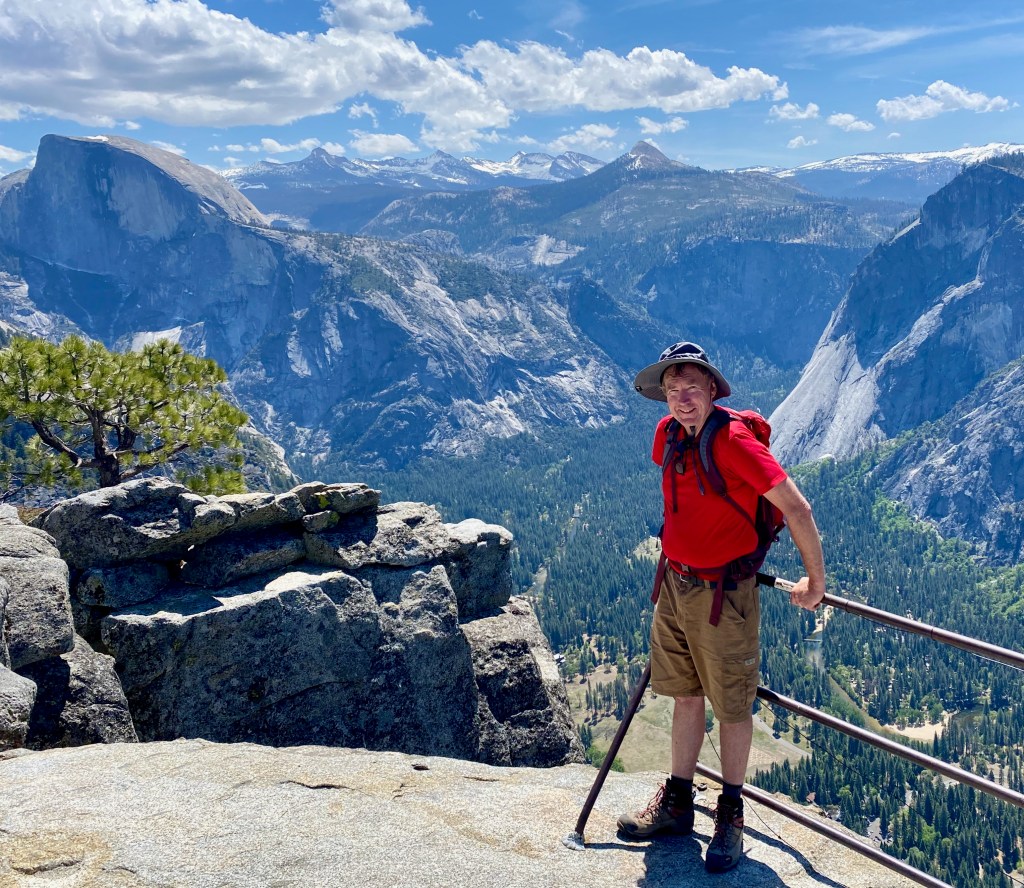
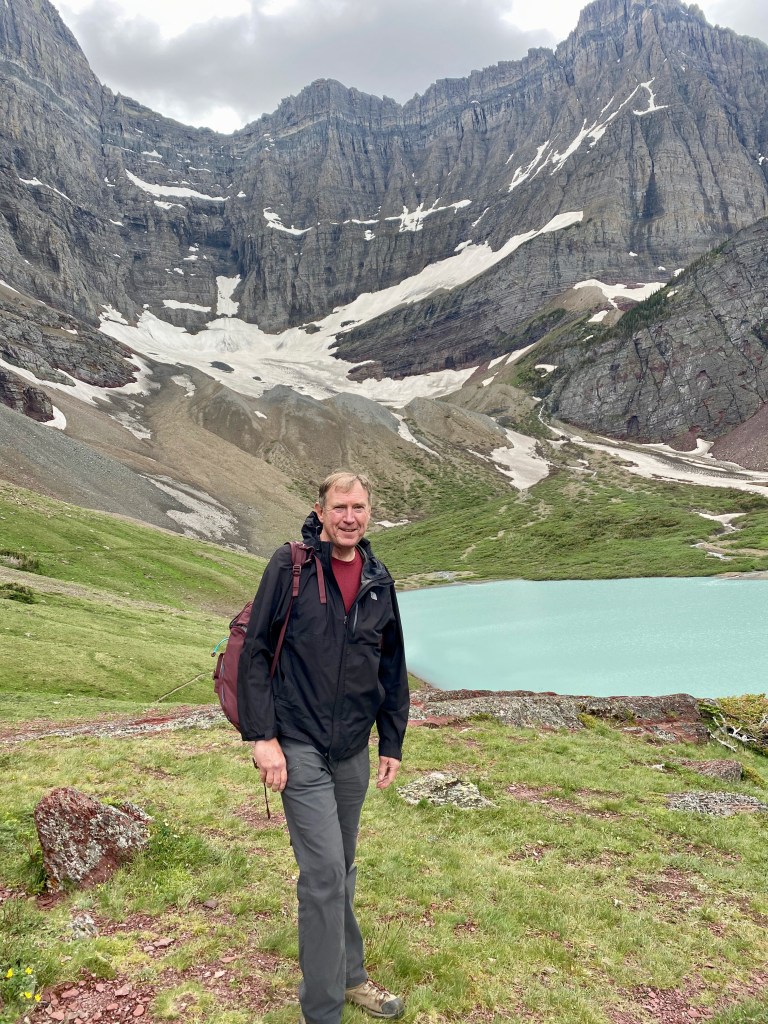
Of all the ways to get exercise, my favorite is hiking through a stretch of beautiful scenery, with a preference for woods, rushing streams, and mountain peaks. In the past year, I’ve been able to indulge my interest as my wife Elizabeth and I—both recently retired—traveled across the United States with an RV in tow, visiting more than 20 national parks. Along the way, I was able to hike some memorable trails in such parks as the Great Smoky Mountains, Big Bend, Yosemite, Olympic, Glacier, and Yellowstone, as well as the mountains of Colorado.
In contrast to a treadmill or a swimming pool, hiking gets you out in God’s creation, breathing fresh air, seeing new sights, with no special skills required other than reasonably good health. And hiking also reminds me of deeper truths by providing a metaphor of our journey through life.
I can think of at least three ways that hiking reminds me of our life in this world. One way is that on the hiking trail, as in everyday life, the more difficult path is often the most rewarding. Steep switch backs up a mountainside can strain our knees and tax our lungs, but they can also take us above timberline to the highest spots where we can see stunning vistas for miles and miles.
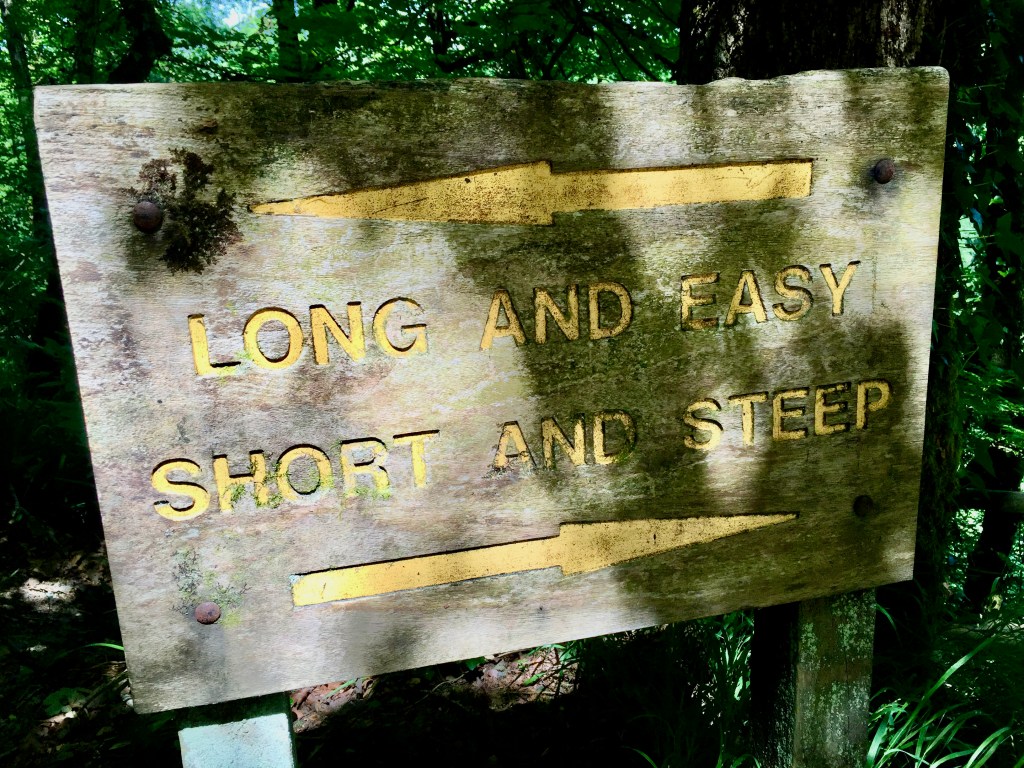
In a hike through Lydford Gorge in southwest England in 2016, we came across a sign at a fork in the path that pointed one way for “LONG AND EASY” and the other for “SHORT AND STEEP.” In this case, both paths led to the same destination, but on other trails, the seemingly easier path can lead us astray. In John Bunyan’s The Pilgrim’s Progress, Christian comes to his own fork in the road, with one path leading up to “Hill Difficultly,” and two others appearing to be easier but labeled “Danger” and “Destruction.” The pilgrim takes the correct path, despite its promise of difficulty, while Formalist and Hypocrisy take the other two, both leading to fatal dead ends. Bunyan concludes the scene with this verse: “Better, though difficult, the right way to go/ Than wrong, though easy, where the end is woe.”
This lesson came home to me the hard way more than 30 years ago when we were living in Colorado and I climbed Pikes Peak for the first time. A popular path to the 14,115-foot summit, Barr Trail, is both long and steep, covering 13 miles and climbing 7,000 feet from the trailhead to the top. More than halfway up, I came to a fork in the road and, probably because I was tiring and my brain was a bit short of oxygen, I missed the sign and took the path that looked easier. It proved to be a side trail leading to a dead end called the “Bottomless Pit.” Once I realized my error, I had to turn around and, back at the fork, continue my journey upward because it was too far to go back down. I eventually reached the summit, exhausted by the extra effort but elated to tears.
Another way hiking mirrors our walk through life is that, in my experience, it’s better to stick to established trails than to blaze one’s own path. This doesn’t mean that we mechanically follow the crowd, but that we humbly rely on the wisdom of those who’ve walked before us. As the Lord spoke through the prophet Jeremiah, “This is what the Lord says: ‘Stand at the crossroads and look; ask for the ancient paths, ask where the good way is, and walk in it, and you will find rest for your souls.’” (Jeremiah 6:16).
Sticking to a marked path can avoid unnecessary trouble while leading us to the most rewarding destinations. If you try to find your own way by leaving an established trail, you can end up in a thicket, or going in circles, or worse. In fact, established paths are the best and often the only way to reach our desired goals, whether it’s an overlook at the rim of Yosemite Valley, success in your profession, happiness in marriage, or eternal rest with God in the Celestial City. In all those journeys, I’m grateful for the more “ancient paths” that have been blazed before us.
Years ago I read Tolkien’s The Hobbit to our three children. Early in the book, Gandalf warns the hobbits to follow the Old Forest Road as the best way to get through the “cursed forest”:
Stick to the forest-track, keep your spirits up, hope for the best, and with a tremendous slice of luck you may come out one day and see the Long Marshes lying below you, and beyond them, high in the East, the Lonely Mountain where dear old Smaug lives, though I hope he is not expecting you.
Many readers will know how the story unfolds. Despite the wizard’s warning, the hobbits stray from the path and end up lost and at the mercy of the wood elves. For the hobbits, as for us, sticking to the path and doing what’s right, far from being boring and predictable, can lead to the adventure of a lifetime.
Many beautiful and well-established trails remain uncrowded exactly because they are strenuous and remote. I recently hiked a 9.5-mile loop along the Fiery Gizzard Trail near Tracy City, Tenn. The white-blazed path led me over moss-covered rocks, along a rushing stream, past waterfalls, and up to scenic overlooks. In my five-plus hours on the trail, I didn’t encounter a single other person, even on a mild 60-degree December day.
A third life lesson I’ve learned from hiking is the reward of steady, sustained, if unspectacular effort. It’s amazing the spots you can reach if you just put one foot ahead of the other mile after mile. On the back end of a two-day, 20-mile backpacking hike in Colorado two years ago, I was able to motivate myself up a steep series of 16 switchbacks by tackling them two at a time, telling myself I’ll savor the view for a minute at every other turn. Before long I was going over the ridge line and on my way back to the parking lot and home.
A corollary to this lesson is not to stop but to keep going even when you’re tiring. When I took that wrong turn on Pikes Peak, feeling weary and a bit discouraged, I fell in with an older and more experienced hiker on his way up. As we plodded along together, he gave me a piece of advice that I’ve always remembered: when you’re tired, keep walking, even if it means taking slower and shorter steps. Better to make slow, steady progress than no progress at all.
I’ve found these rules apply whatever kind of path I’m walking. In the Psalms, the writers took comfort in knowing God was with them wherever they were, whether on a mountainside or in a meadow or a dark valley. In Psalm 18 we read, “[God] made my feet like the feet of a deer and set me secure on the heights.” In Psalm 143, God is asked, “Teach me to do your will, for you are my God! Let your good Spirit lead me on level ground!” And even at the lowest and most difficult moments, Psalm 23 declares, “Even though I walk through the valley of the shadow of death, I will fear no evil, for you are with me; your rod and your staff, they comfort me.”
Whatever path you’re called to walk at this moment in your life, my advice is to not fear the more difficult path, to stick to the trail, and to keep walking, one step at a time, until you reach the end.

 Daniel Griswold's Blog
Mr. Griswold, where are you travelling now?
My wife and I are staying put for the winter at our home in Vienna, VA. We’re planning a few trips for later in 2022–stay tuned! Meanwhile, I’ll continue posting on the blog about books and other observations.