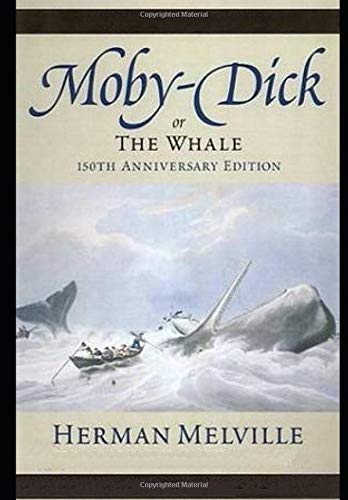
Finished Moby Dick last week (Hertfordshire: Wordsworth Editions Limited, 1993). It’s a wondrous work of genius. Among the more memorable passages was the image of the ship heading into the night with the fire of the blubber boiler blazing on deck (p. 350), the encounter with the Rachel and its distraught captain seeking his son in the missing boat (p. 432), and Ahab peering into the deep to see the open maw of Moby Dick rising to the surface (p. 448– see the cover from another edition below).
Ishmael counts it time to go to sea “whenever it is a damp, drizzly November in my soul.” The sermon early in the book calls us to be “only a patriot of heaven.” Melville describes the sinking of the whale ship Essex by a whale in 1820 on p. 172, which I’ve read may have inspired him to write the book.
I loved the descriptions of the sea, such as this passage on p. 442 just before the final encounter with the white whale:
It was a clear steel-blue day. The firmaments of the air and sea were hardly separable in that all-pervading azure; only, the pensive air was transparently pure and soft, with a woman’s look, and the robust and man-like sea heaved with long, strong, lingering swells, as Samson’s chest in his sleep.
Or this as the Lakeman on p. 215 recounts an encounter with Moby Dick where “the appalling beauty of the vast milky mass, that lit up by a horizontal spangling sun, shifted and glistened like a living opal in the blue morning sea.”
The most sympathetic character to me was Starbuck, the first mate who appealed in vain to the captain to give up his monomaniacal quest. I would want to be him in such a forbidding situation—competent, loyal, yet speaking the truth to power and guarding the general interest of others. Starbuck said, “I will have no man in my boat who is not afraid of a whale.” Melville writes that, “By this he seemed mean that not only the most reliable and useful courage was that which arises from the fair estimation of the encountered peril, but that an utterly fearless man is a far more dangerous comrade than a coward.” In a final confrontation, Ahab waves a pistol at Starbuck and orders him on deck. But Starbuck, “mastering his emotion, he half calmly rose, and as he quitted the cabin, paused for an instant and said: ‘Thou has outraged, not insulted me, sir; but for what I asked thee not to beware of Starbuck; thou wouldst but laugh; but let Ahab beware of Ahab; beware of thyself, old man.’”

 Daniel Griswold's Blog
Thank you, Dan! Another great book–one of my favorites. I hope you and Elizabeth are having a warm and safe new year thus far. So grateful for you.
Thank you, Charles! Same to you and Margaret and your dear girls.