Rating the 22 national parks we visited in 2021: From Yosemite and Glacier to Wind Cave and Lassen Volcanic

One of the organizing principles of our RV trip around the country this year was visiting as many national parks as we could. We love the outdoors, and one of my passions is hiking to beautiful spots. I collected national park brochures along the way like a big game hunter collecting mounted trophies.

In the course of our eight-month, 10,500-mile journey, we visited 22 national parks. I’ve blogged in more detail about each of them, but I thought it would be useful to list the parks here and briefly note the highlights of each, with links to the relevant blog posts I wrote at the time of our visit.

Our trip reminded me that our national park system is a treasure. Ken Burns went a step too far in saying the parks are “America’s best idea.” I would assign that honor to limited, constitutional government and the guarantee of individual rights. But national parks were a very good idea, and I’m grateful for the foresight that was exercised to preserve these places for the public’s enjoyment. We found the park facilities generally well run and park service employees helpful and usually friendly, although the facilities were often stricter about COVID rules than society in general.

Since we’ve been asked a few times what were our favorite national parks of those we visited, I’ll organize the list below starting with the parks that were the most awesome down to those that were merely interesting to visit.

At the top of the list:

Yosemite (California). Top sights were the water falls and the views from the valley and the rim. See “Hiking to the top of Upper Yosemite Falls.” and “A final misty hike.”

Yellowstone (Wyoming). We saw Old Faithful, hot springs, and lots of wildlife. See “Camping near bison.”

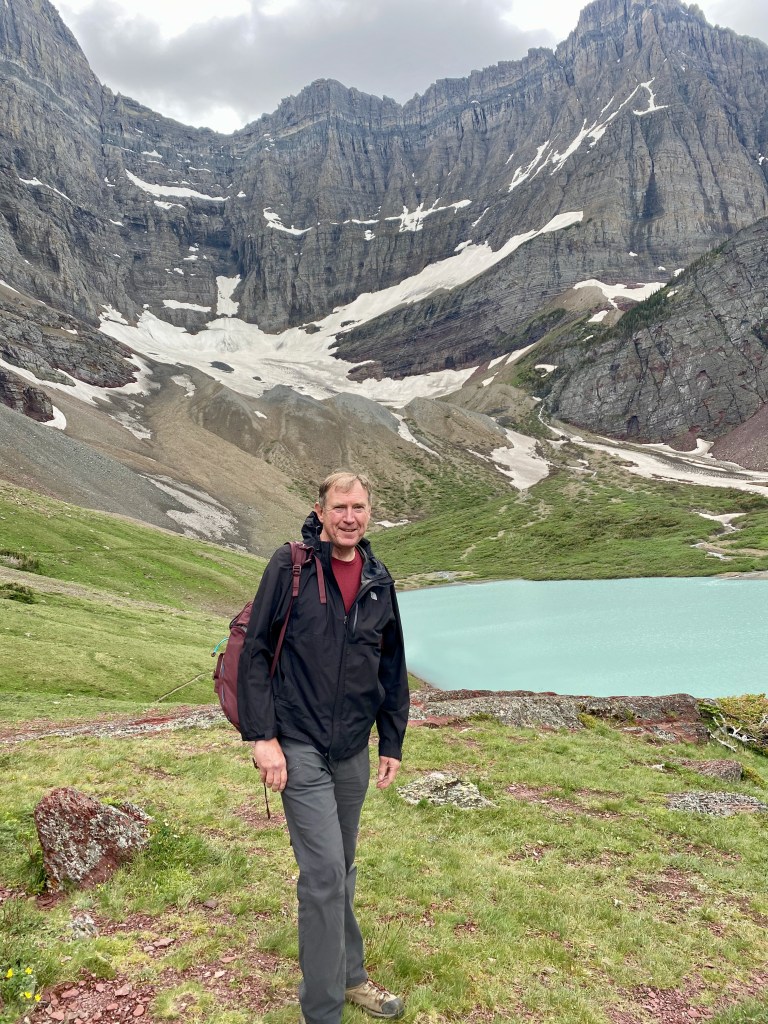
Glacier (Montana). We hiked to glacial lakes, encountered a black bear, boated on Lake McDonald, and drove the Going to the Sun Road up to Logan Pass. See “Sampling the wonders of Glacier.”

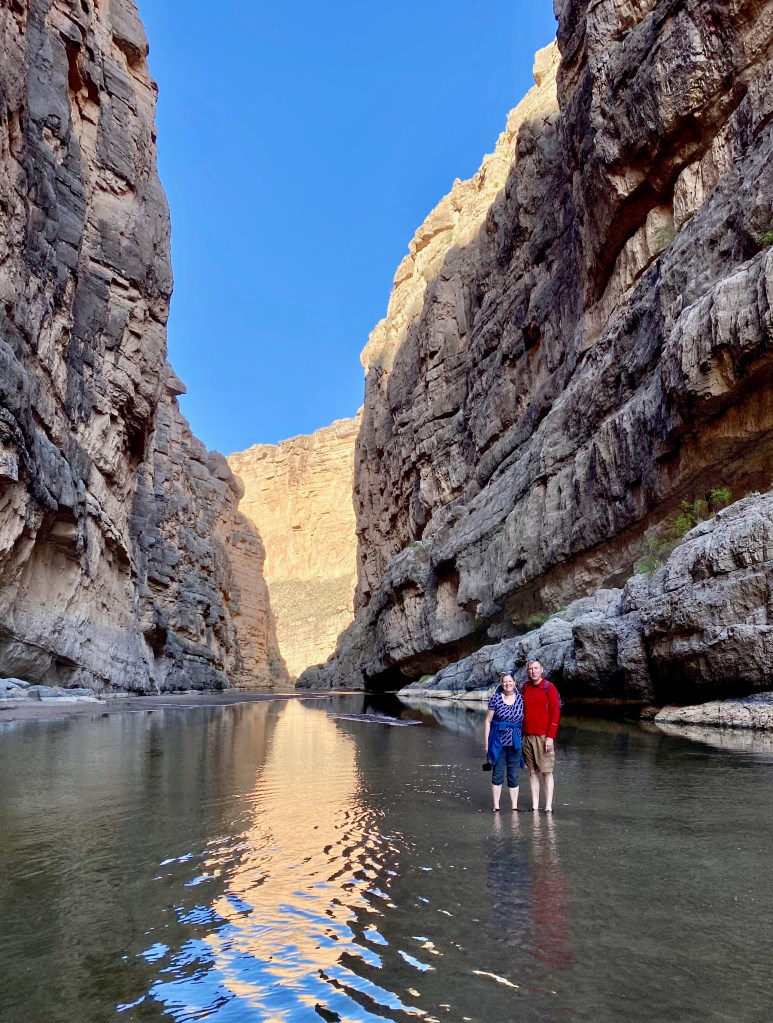
Big Bend (Texas). We waded in the Rio Grande River, and hiked into canyons and through the Chisos Mountains. Our visit there was eventful enough to rate three blog posts! See “Boondocking in Big Bend,” “Hiking the South Rim,” and “Hiking into Santa Elena Canyon.”

Other favorites:

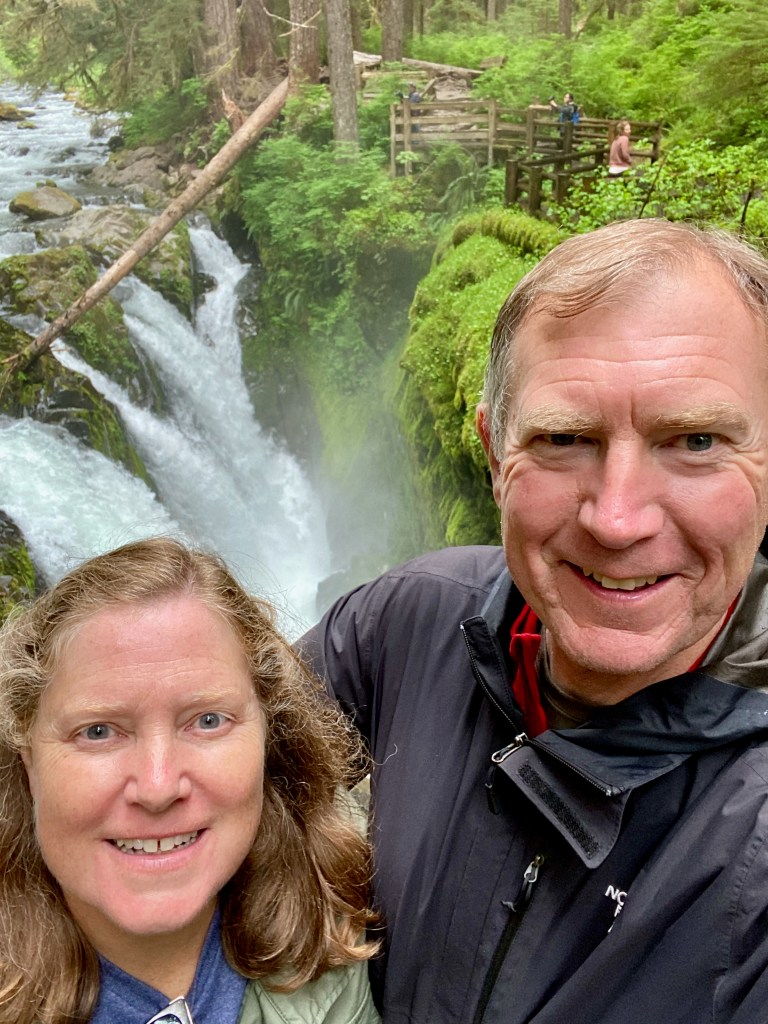
Olympic (Washington). We hiked up to Hurricane Ridge, biked along Lake Crescent, and visited Sol Duc Falls. I ventured into the Hoh River Rain Forest on a two-night backpacking trip. See “Hiking Hurricane Ridge” and “Backpacking into the enchanted wilderness.”

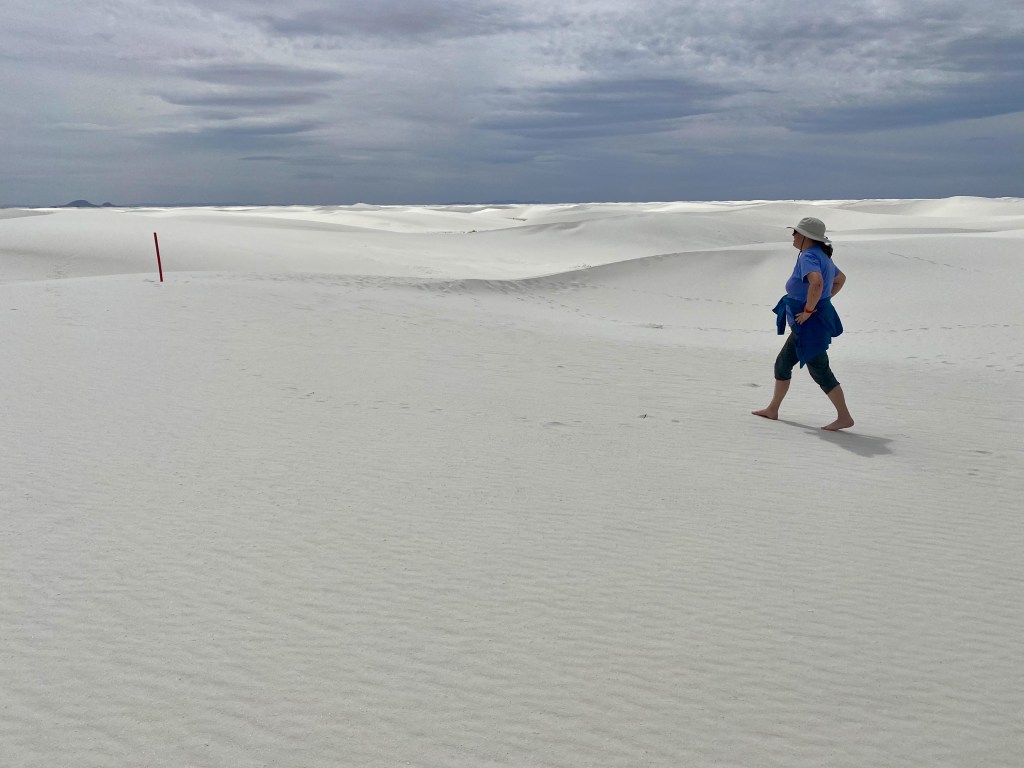
White Sands (New Mexico). This park and Big Bend were the two that exceeded expectations by the widest margins. We loved our five-mile walk in bare feet across the cool sand to the Alkali Flats and back. See “The otherworldly expanse of White Sands.”

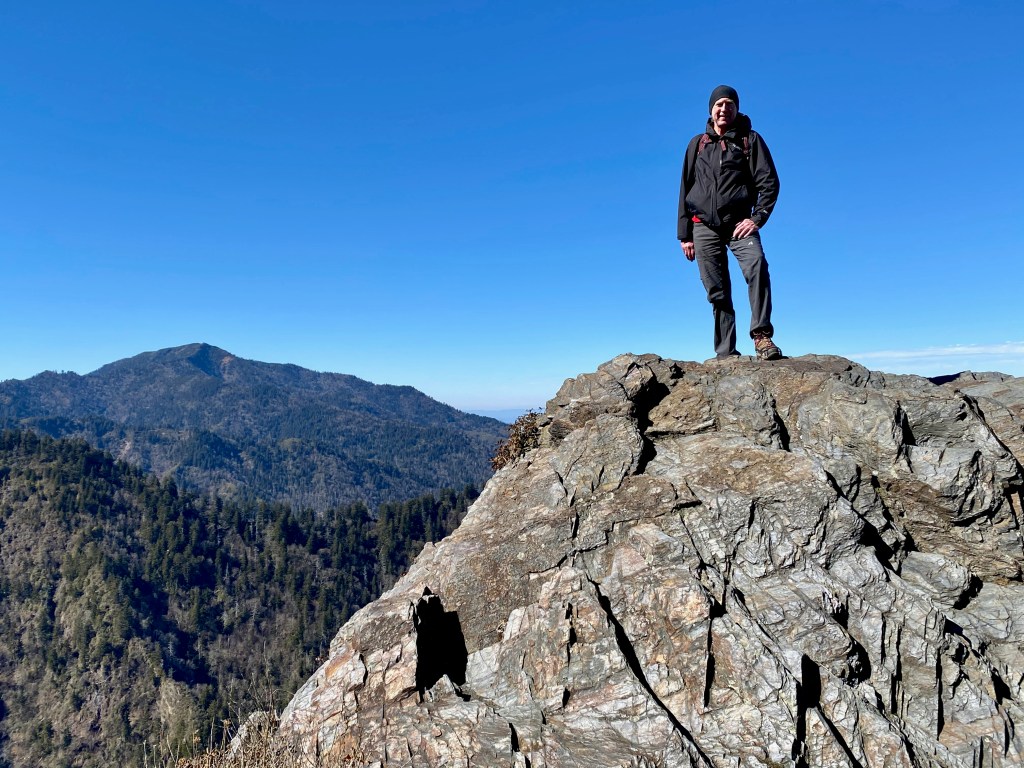
Great Smoky Mountains (Tennessee/North Carolina). We’ve visited here before, hiking the Alum Cave Trail to Mount LeConte. During this trip, I hiked a four-mile section of the Appalachian Trail to Charlies Bunion on a winter’s day for amazing views. See “Hiking the Appalachian Trail.”

Carlsbad Caverns (New Mexico) and Guadalupe (Texas). The caverns are spectacular and make just about all other cave systems rather ordinary. Just down the road Guadalupe offers great views from the highest point in Texas and unique terrain shaped by an ancient sea. See “From Carlsbad Caverns … to Guadalupe Peak.”

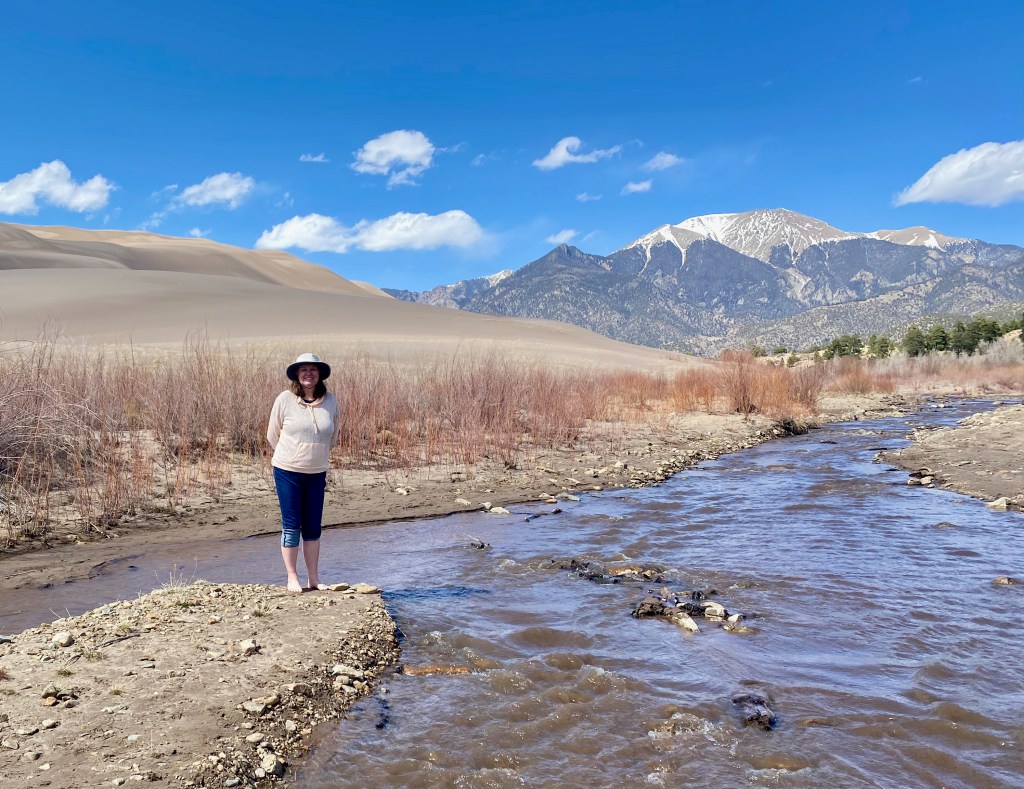
Great Sand Dunes (Colorado). Be sure to go here in spring or early summer when the water is running through Medano Creek. Otherwise it’s just a big pile of hot sand. See “Great Sand Dunes National Park.”

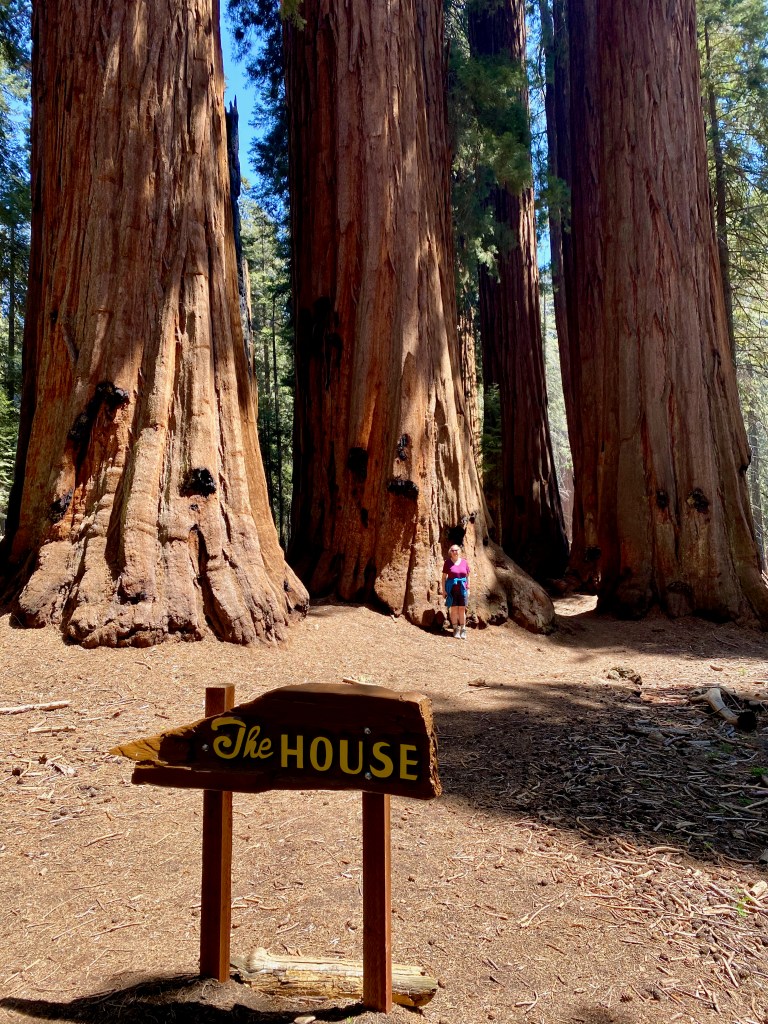
Sequoia, Kings Canyon, and Redwood (California). The main attraction at all three are the towering redwoods. We savored every quiet moment along the pine-needle paths with the trees towering 200-300 feet above us. See “Standing tall with Generals Sherman and Grant” and “Admiring the giant redwoods.”
Other parks:

Hot Springs (Arkansas). The main attraction in this small, urban park is the hot springs, which we thoroughly enjoyed during our 20-minute session in a private bath. See “Soaking in hot springs.”

Saguaro (Arizona). We learned a lot about the desert and its plant life at the park and the nearby desert center. We were only able to tour the west unit. See “Admiring the sentinels of the desert.”

Joshua Tree (California). This park is worth visiting for a full day, but the hiking opportunities are limited. See “Joshua Tree National Park.”

Lassen Volcanic (California). The park’s main road was still closed for snow removal when we visited in May, so we were only able to experience a sulfur-scented mud pot at the entrance. See “Smelling sulfur and feeling the heat.”

North Cascades (Washington). We enjoyed the view of Diablo Lake from the main road, but the hiking opportunities seem to be limited. See “The clouded peaks of North Cascades National Park.”

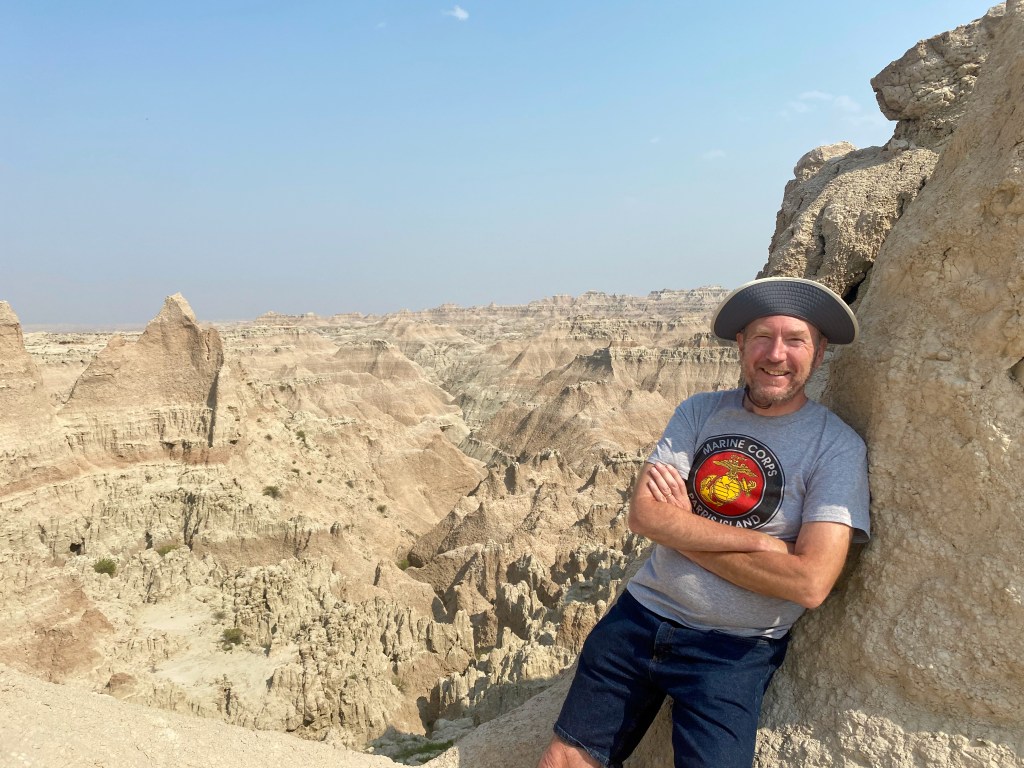
Badlands and Wind Cave (South Dakota). These two parks are about 70 miles apart. I hiked out onto the Badlands and savored the stark landscape. Wind Cave features some unique formations, but the tours were limited and they only offer same-day reservations. See “A glorious day in the Black Hills.”   

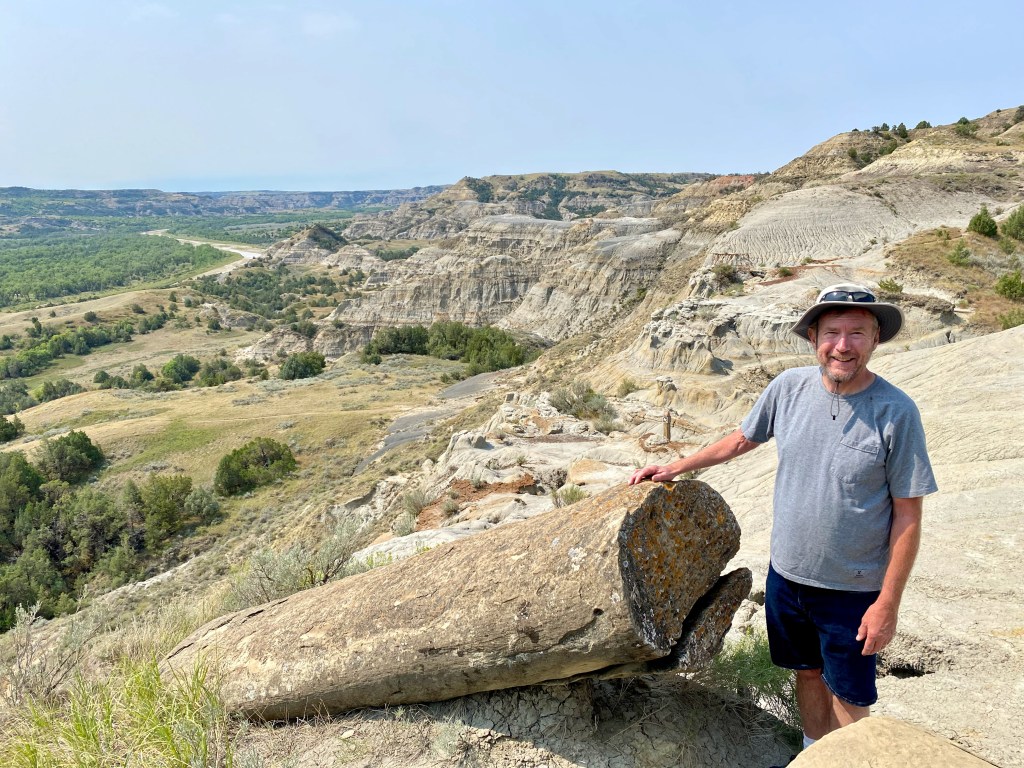
Theodore Roosevelt (North Dakota). This remote park (especially the north unit) offered its own more subtle “badlands” beauty and historical ties to a former U.S. president. See “Following ‘The Little Mo’ and the buffalo.”

New River Gorge (West Virginia). We enjoyed a hike along the ridge 1,400 feet above this picturesque river. If we visit again, we might try rafting. See “Gazing down on West Virginia’s New River Gorge.”  
***

Along our journey there were at least six parks that we could have visited but for various reasons we weren’t able to: The Grand Canyon (Arizona) was just a bit out of the way and we could not find a campsite reservation nearby; the rim road around Crater Lake (Oregon) was still snowed in when we arrived in southwest Oregon in mid-May; Mount Rainier (Washington) was also a bit out of the way as we made our way from Washington to Montana in June; we passed near the Grand Tetons (Wyoming) in July but there were no available campsites when we got around to inquiring; Voyager (Minnesota) in Northern Minnesota was also a bit out of the way for us; and Isle Royale (Michigan) was only a three-hour ferry ride away when we were in Copper Harbor, MI, but I had left the reservations too late and the ferry and lodge were all booked up.

Oh well, we’ll just need to plan another trip one of these years, Lord willing!
Book notes: Looking for a good read? My favorite authors and titles on history, theology, fiction, and political economy

People occasionally ask me for book recommendations. I’m happy to oblige! Below are books I’ve read over the years that I would heartily recommend to anybody who hasn’t had the opportunity to read them yet.

They’re grouped into four categories: History and Biography; Fiction; Religion and Theology; and Political Economy. Most recommendations come with a sentence or two about the work.

History and Biography

At the top of my list:

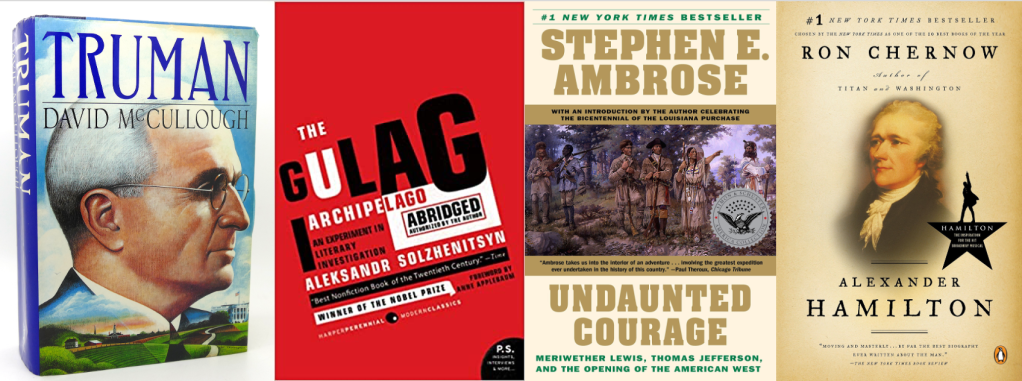
Alexander Hamilton and Grant by Ron Chernow. Both books are masterful at painting their subjects and their times, capturing the sweep of history as well as the telling detail.

Anything by David McCullough. Truman is at the top of the list, followed by The Wright Brothers, John Adams, The Path Between the Seas: The Creation of the Panama Canal, 1870-1914, and The Johnstown Flood. I just finished Mornings on Horseback, the story of Theodore Roosevelt’s early years, including his time in the Badlands of North Dakota.

Anything by Erik Larson. My favorite is Isaac’s Storm: A Man, a Time, and the Deadliest Hurricane in History, a vivid account of the Galveston hurricane of 1900, still the deadliest natural disaster in American history. Other favorites are The Devil in the White City, about a devious serial murderer operating on the fringes of the 1893 Chicago world’s fair; and Dead Wake: The Last Crossing of the Lusitania.

The Gulag Archipelago by Alexander Solzhenitsyn. I first read this in my 20s and it had a profound effect on my view of the socialist experiment. I recommend the one-volume, abridged version, published with the author’s approval and input.

The Storm of War: A New History of the Second World War and Churchill: Walking with Destiny by Andrew Roberts. Roberts plumbs new sources and weaves a compelling narrative to illuminate these two well-covered subjects. My favorite story from the Churchill biography is the speech Harry Hopkins gave in Glasgow in January 1941, quoting the book of Ruth. It made Churchill weep.

Unbroken: A World War II Story of Survival, Resilience and Redemption by Laura Hillenbrand. The movie was good, but the book is even better. The story of Louis Zamperini’s conversion was as compelling to me as his survival and imprisonment in the Japanese POW camp.

Undaunted Courage: Meriwether Lewis, Thomas Jefferson, and the Opening of the American West by Stephen E. Ambrose. Compelling story of the Lewis and Clark expedition.

Battle Cry of Freedom by James M. McPherson. A one-volume history of the Civil War, not just the battles but also the economic and cultural forces that stoked the conflict.

More History

The English and Their History by Robert Tombs. This one-volume history is a heavy lift at 900 pages but my reward was a much deeper appreciation for English history and how it has shaped their and our own culture and politics today.

The Rise and Fall of the Third Reich: A History of Nazi Germany by William L. Shirer. A one-volume history of the regime by an American reporter who witnessed much of it from inside Germany.

Night by Elie Wiesel. The dark night of the Nazi death camps was broken by American tanks.

Gulag: A History by Anne Applebaum. A more comprehensive companion to Solzhenitsyn’s work.

To round out the tour of 20th century totalitarianism, I recommend Mao’s Great Famine: The History Of China’s Most Devastating Catastrophe, 1958-62 and The Cultural Revolution: A People’s History, 1962-1976 by Frank Dikötter.

On the other world war, I recommend The First World War by John Keegan and A Storm in Flanders: The Ypres Salient, 1914-1918: Tragedy and Triumph on the Western Front by Winston Groom.

The Last Stand of Fox Company: A True Story of U.S. Marines in Combat by Bob Drury. My son Paul recommended this one. It’s the story of a band of outnumbered Marines who held out against waves of Chinese attacks under brutal winter conditions during the Korean War. I’ll never forget the scene when relief finally arrived on a distant ridge.

Two books by Candice Millard: Destiny of the Republic: A Tale of Madness, Medicine and the Murder of a President tells the story of how the admirable President Garfield died at the hands of an assassin and an incompetent doctor; and The River of Doubt: Theodore Roosevelt’s Darkest Journey recounts the ex-president’s almost fatal adventure down an unexplored tributary of the Amazon.

Nothing Like It in the World: The Men Who Built the Transcontinental Railroad 1863-69 by Stephen E. Ambrose. This book made me appreciate the work of Chinese immigrants in building the difficult section through the Sierra Nevada mountains.

Mayflower: A Story of Courage, Community, and War; and In the Heart of the Sea: The Tragedy of the Whaleship Essex by Nathaniel Philbrick. The former expanded my meager knowledge of 17th-century America, including the beautiful image of the “praying Indians.” The latter begins with an encounter with a whale that would inspire Herman Melville to write Moby Dick.

Lone Star: A History of Texas and The Texans by Fehrenbach, T.R. A rich, one-volume history of the state that captures its culture and “brooding immensity.” (I read it during our month of travel through Texas in May 2021.

More Biography

Margaret Thatcher: The Authorized Biography by Charles Moore. This is another commitment, but if you admire Mrs. Thatcher and have an interest in British and Cold War politics, all three volumes are magnificent: Volume One: From Grantham to the Falklands; Volume Two: At Her Zenith: In London, Washington and Moscow; and Volume Three: Herself Alone. (Based on Moore’s impeccable scholarship, I was well equipped to expose the inaccurate and unfair caricature of Mrs. Thatcher in the fictional drama “The Crown” in this essay.)

The Last Lion: Winston Spencer Churchill: Visions of Glory, 1874-1932 by William Manchester. Another masterful portrait of a man and his time.

Gladstone: A Biography by Roy Jenkins. Gladstone is perhaps my favorite politician of all-time. He was right on the major issues of his time, including free trade, and he was a serious Christian who practiced his faith in public and private.

The Dawn Watch: Joseph Conrad in a Global World by Maya Jasanoff.

Johnny Cash: The Life by Robert Hilburn.

Narrative of the Life of Frederick Douglass by Frederick Douglass.

Man on the brink

My friend Mac Olson would appreciate this sub-category. These are all riveting stories of people confronting circumstances that both defy and capture the imagination.

Endurance: Shackleton’s Incredible Voyage by Alfred Lansing. Nothing I’ve read in the genre tops this incredible story of survival.

Into Thin Air: A Personal Account of the Mount Everest Disaster by Jon Krakauer. Once I started reading this book, I could not put it down.

The Perfect Storm: A True Story of Men Against the Sea by Sebastian Junger. You know the cliche, but here is the real thing. Unforgettable descriptions of mammoth waves and what it’s like to drown.

Unsinkable: The Full Story Of The RMS Titanic by Daniel Allen Butler. The true story behind the blockbuster movie, comprehensively and expertly told.

Fiction

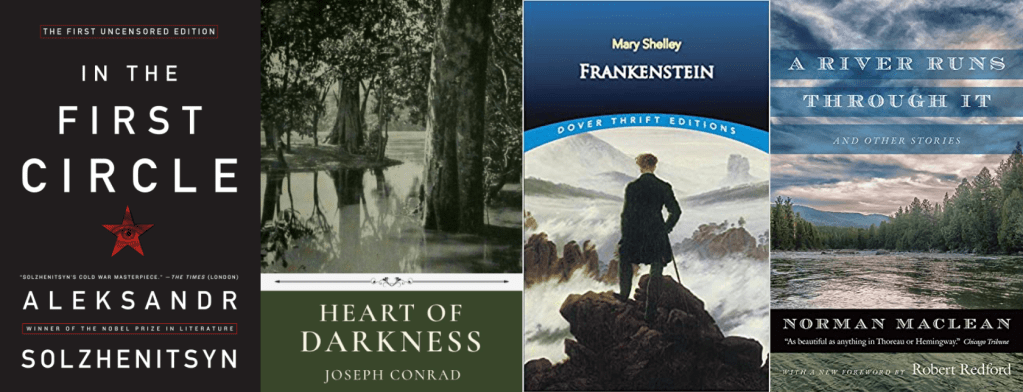
Two novels and a novella by Alexandr Solzhenitsyn: Cancer Ward; In the First Circle: The First Uncensored Edition; and One Day in the Life of Ivan Denisovich. These are all technically fiction, but based on the author’s experience in the Soviet prison camp system. All are filled with unforgettable characters living under circumstances that we thankfully can only dimly imagine. I discuss the first two works and The Gulag Archipelago in this blog post in May.

Anything by Tom Wolfe. Of his fiction books, I enjoyed The Bonfire of the Vanities, A Man in Full, and I am Charlotte Simmons. [Among his non-fiction works, let me sneak in plugs for The Right Stuff and The Kingdom of Speech, the latter a fascinating tour of the development of human of language, in particular how the theory of evolution struggles to explain this human faculty.]

Crime and Punishment, The Brothers Karamazov, The Idiot, and The Possessed by Fyodor Dostoevsky. No author I’ve read plunges the depths of the human soul like the 19th-century Russian. The Possessed offers an all-too-modern look into the mentality of violent political fanatics. His short story White Nights is captivating.

Quo Vadis by Henryk Sienkiewicz. My daughter Emily read this in high school and recommended it. It tells the story of Christian conversion, love and survival in the pagan Roman empire.

A River Runs Through It by Norman McLean. A beautiful memoir of growing up in Montana.

Frankenstein by Mary Shelley. This is nothing like the the popular perception based on movie adaptations. It’s a haunting story of human pride and an inhuman desire for revenge.

A Town Like Alice by Nevil Shute.

The Catcher in the Rye by J.D. Salinger.

Moby Dick and Billy Budd, Sailor by Herman Melville.

Heart of Darkness, Typhoon and Lord Jim by Joseph Conrad.

The Ox-Bow Incident by Walter Van Tilburg Clark.

Religion and Theology

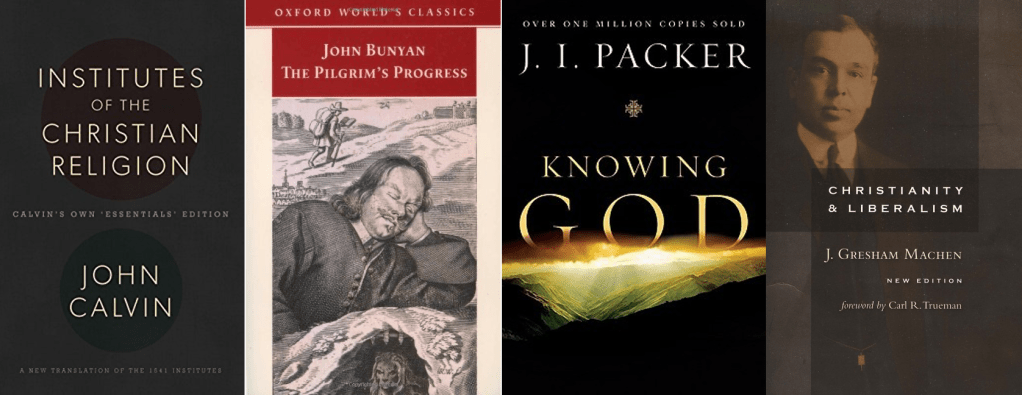
Institutes of the Christian Religion by John Calvin. Systematic in explaining and defending the reformed faith, and also devotional in its warm-hearted appeal to Christians to live out their faith. I recommend either (or both!) the final 1559 version, a two-volume set edited by John T. McNeill, and/or the 1541 “Essentials” Edition, translated by Robert White, which is a few hundred pages shorter.

The Pilgrim’s Progress by John Bunyan. An unforgettable journey to the Celestial City.

Knowing God by J.I. Packer. I learned a lot about the Holy Spirit from this book.

Confessions by Augustine. Written 1,600 years ago but modern in its personal and confessional style.

Christianity and Liberalism by J. Gresham Machen. Machen said later that this would have been better titled Christianity and Modernity. In critiquing the liberal church of his day, he lays out in clear and learned prose the essentials of the Christian church and faith.

Anything by C.S. Lewis. Beyond the usual favorites, such as Mere Christianity and The Screwtape Lertters, I would recommend Miracles, The Abolition of Man, and God in the Dock: Essays on Theology and Ethics.

A Severe Mercy: A Story of Faith, Tragedy and Triumph by Sheldon Vanauken. A beautiful story of how losing what you love most in this world can lead to finding eternal joy in Christ.

The Peacemaker: A Biblical Guide to Resolving Personal Conflict by Ken Sande. Biblical, practical lessons in making and keeping peace with your neighbor.

Foxe’s Book of Martyrs by John Foxe.

Confessing the Faith: A Reader’s Guide to the Westminster Confession of Faith by Chad B. Van Dixhoorn.

Tortured for Christ by Richard Wurmbrand. Heart-wrenching ordeal of a pastor serving the Lord faithfully under the especially cruel communist regime of Romania.

Political Economy

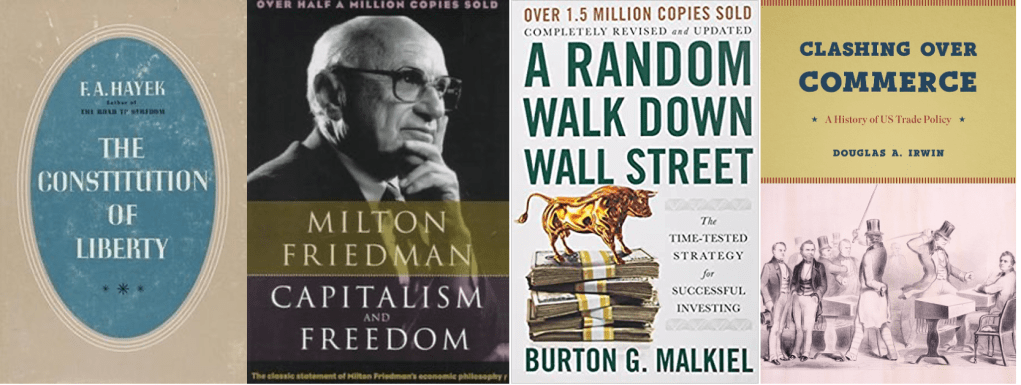
The Constitution of Liberty by Friedrich Hayek. His The Road to Serfdom is more widely read, but this longer work lays out in a powerful and comprehensive way the rules for a free society.

Capitalism and Freedom and Free to Choose: A Personal Statement by Milton Friedman. You can’t beat Friedman for stating the case for a free economy and society in a civil and engaging way.

The Box: How the Shipping Container Made the World Smaller and the World Economy Bigger by Marc Levinson. A must read if you want to understand today’s headlines about ports, container ships, and supply chains.

Clashing over Commerce: A History of US Trade Policy by Douglas A. Irwin. If you are into trade policy, this is THE definitive history of how our nation escaped from protectionism to a more open and interconnected economy.

The Worldly Philosophers by Robert L. Heilbroner. An engaging tour of the great economic thinkers of the past few centuries.

A Random Walk Down Wall Street: The Time-Tested Strategy for Successful Investing by Burton G. Malkiel. This book, along with Stocks for the Long Run: The Definitive Guide to Financial Market Returns & Long-Term Investment Strategies (5th edition) by Jeremy Siegel and The Little Book of Common Sense Investing by John C. Bogle, taught me how to manage our retirement portfolio without paying high fees to “active fund” managers. (I distilled what I learned into this essay, Saving for Retirement — What Every Millennial Should Know.)

Mad about Trade: Why Main Street America Should Embrace Globalization by Daniel Griswold. This book is last and arguably least in this august list, but how could I not recommend my own work? Seriously, although it was written a decade ago, this is a clear and comprehensive explanation why Donald Trump and the AFL-CIO are wrong about trade and globalization, and how trade makes our lives better every day.

Closing the loop: Looking back on our coast-to-coast, 10,500-mile RV journey across America

DUMFRIES, Va.—After nearly eight months on the road, we spent a few days at our home base of Northern Virginia this week, closing a grand loop we traveled around the United States that you can see on the map below. Our journey began when we left the area on Feb. 9 and covered 10,500 miles towing the travel trailer, 63 campgrounds, 24 states, 22 national parks, and reunions with family and friends from California to Michigan.

We survived challenges along the way, as I described in this post in August, but on the whole our adventure has been a great success. It’s allowed us to see places and people we would probably not get to see if we had needed to book a regular kind of vacation, with flights, hotels, and rental cars.

Among the more memorable moments for me were wading up the Rio Grande River through the Santa Elena Canyon in Big Bend National Park, hiking to the top of Yosemite Valley, stalking wild bison in Yellowstone and the Dakotas, and swimming in the blue expanse of Lake Superior. (I’ll write a separate post soon rating the national parks we visited.) As for family, we saw all three of our children, siblings, nephews, a niece, and all 14 of my late mom and dad’s great grandchildren (in order of our visits: Davis, Mae, Max, Clara, Aben, Owen, Gabriella, Grace, Milo, Alina, Evvie, Elise, Finn, and Ford).

We’ve interacted with all kinds of people in the campgrounds where we’ve stayed. People in RV parks are almost always friendly and represent a cross-section of Americans. The most well represented groups are middle-class retirees like us, followed by parents on vacation with their kids (mostly during the summer), and people living in their RVs as they try to get established. In Lemon Cove, CA, our neighbor Brian and his family were living in an RV they bought and had towed to the site while they looked for permanent housing and a truck that could pull the RV. In Colorado Springs, CO, David and his family were living in the RV next door while they looked for a home they could afford. (See my July review of the book and movie “Nomadland” for more on this phenomenon.) The oldest RVer we met was a 98-year-old man at the campground near Yosemite who was still towing a fifth-wheel (with his daughter and son-in-law accompanying him in their small motor home).

We have our challenges as a nation, but I can report from spending most of 2021 traveling from one end of this country to the other and back that large swaths of America remain peaceful, prosperous, and friendly. The towns we stayed in and passed through weren’t so much divided by rich and poor as by those that are thriving and those that are just hanging on or slowly fading. Such places as Red Lodge, MT, Cody WY, Port Angeles WA, Placerville CA, are not enclaves for the rich, but they are prospering towns with well-kept businesses and neighborhoods. We also drove through small towns that were marked with boarded up storefronts and an older stock of houses. The roads and bridges that carried us on our way were generally in good shape, contrary to the claims of “crumbling infrastructure.”

Traveling by RV is a great way to see the country but it also has its limitations. It’s an ideal way to visit friends and family, allowing us to see them without asking for a place to stay. We can also host people for a cookout or time around the campfire. It’s more like being their temporary neighbors than houseguests. For a longer trip, traveling by RV saved us from expenses for flights, rental cars, hotels, and eating out for just about every meal. It’s a minor miracle that we can drive down the road 200 miles to a completely new place and still inhabit our 227-square-foot efficiency apartment with all our familiar stuff.

One limitation of RV travel is flexibility. It’s much more difficult to stray from the path between destinations to visit some interesting site. Somebody called it the “hub and spoke” approach to travel: We travel straight to our next campground destination, and then unhitch the truck to explore what we can from our new base camp. That means if there’s an interesting spot halfway between two campgrounds, we might need to drive 100 miles or more each way to reach that spot. It means we’ve missed a few tourist sites that we could have more easily bagged if we had just been driving a car.

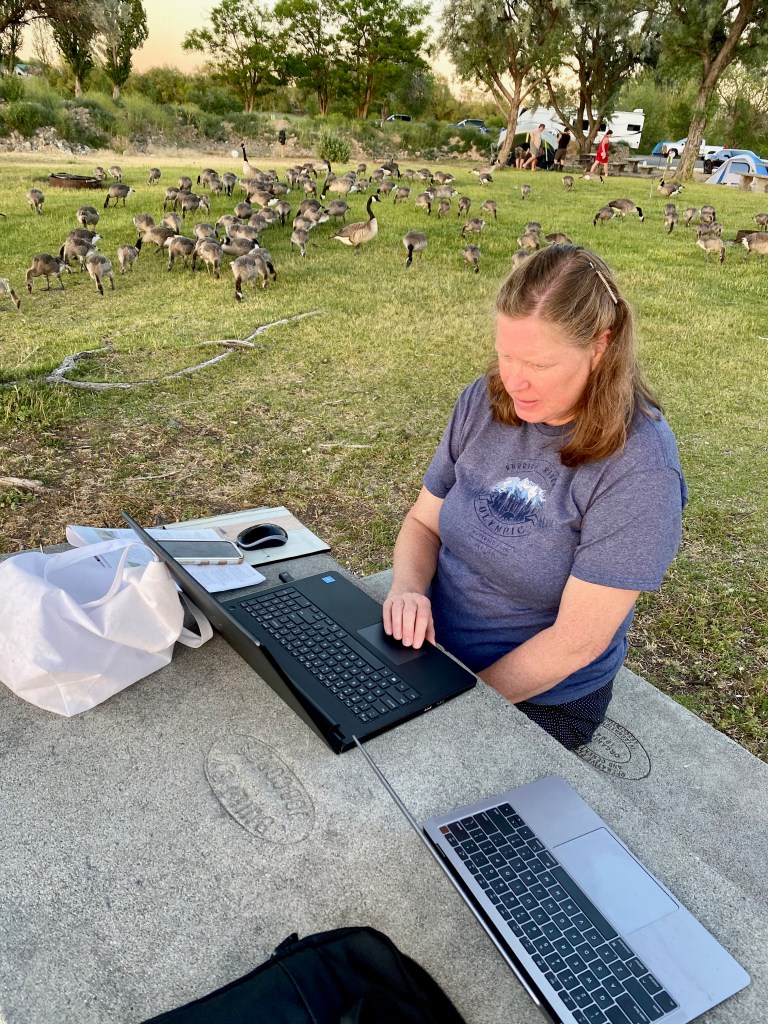
Another running issue in an RV is connectivity. Many of the places we stayed at were in beautiful natural surroundings but far from an urban area with a cellular signal. Campground wi-fi is notoriously spotty. One place told us, “Remember, this is country wi-fi,” meaning the signal was weak and prone to be overloaded. Some parks specifically prohibited streaming. We paid Verizon for a “jet pack” that converts the local cell signal into a wi-fi hotspot in our camper. But we also pay extra for the data we stream through it, which is limited and good for three or four movies at most before the monthly data allotment is used up.  Often our best connection is using our iPhones as hotspots, but the data is limited there, too. As a result, we were forced in some places to travel to hill tops or parks in town to get a decent signal. (Here’s a photo I posted back in June of Elizabeth filing the church prayer list from a park in Coulee City, WA.)

Yet another challenge has been finding Christian fellowship. In our entire time on the road, we made a point not to travel on Sundays so that we could find a place to worship with other believers and rest from our regular duties. We looked for reformed Presbyterian churches when nearby, but we also saw this as an opportunity to experience how other Christians worship on Sundays. We’ve been to Baptist and Lutheran churches, a big, contemporary non-denominational church, and a “cowboy church” (in Texas, of course!).  We’ve missed the regular fellowship and accountability of the local church, but in every one of the places of worship we visited, the people were welcoming and the gospel was preached.

Life on the road can also be an interior journey. I’ve learned more about myself, on the upside as well as the downside. Without any prior training, I found out I can hitch, tow and back a 7,000-pound trailer and fix quite a few problems myself as they come up. Elizabeth and I have also learned more about working together as a couple. (Guys, it’s a beautiful sight to see your spouse wielding a rubber mallet to pound an iron bar into submission.) But living in a confined space also limits the opportunities to go off and do things on your own. I’ve had to learn a few lessons on this trip about holding my tongue more often, conceding the last word in a discussion, and being content to let things work themselves out.

Being retired from any paid work, I’ve also had more time to read in the RV. Since we set sail in February, I’ve read about 20 books, mostly on history, but also about science and geology. It’s a wonderful fact that when you’ve lost yourself in a book, it doesn’t matter if your easy chair is in an RV or a mansion. I’ve had the pleasure of reading about the naturalist John Muir while we explored the places he loved, and most recently about Theodore Roosevelt’s “mornings on horseback” with our memories still fresh from our time in the Badlands of North Dakota.

Elizabeth and I are both grateful to God for this opportunity to see all these places in the United States that are so full of history and beauty. And we’re thankful that over these almost eight months and more than 10,000 miles that we’ve been spared any accidents or major problems with the rig. And we’re thankful for the great time we’ve had as temporary neighbors to the family and friends we’ve been able to visit.

***

Although we’ve completed the loop, our journey continues. We left our base in Northern Virginia yesterday to spend a few days at a campground near the beach in Rodanthe on the Outer Banks of North Carolina. Over the next few weeks we’ll continue to travel south along the coast, enjoying the sights and the relatively warmer weather until we return to our home in Vienna toward the end of the year. In the meantime, you can pray we won’t need to ride out any hurricanes in the RV!