One book I’ve finished on this RV trip is Alexander Solzhenitsyn’s novel Cancer Ward. A Christian brother recommended it three decades ago, telling me that it was so vivid in its portrayal of patients in a Soviet hospital in the 1950s that he felt like he had cancer himself.
Solzhenitsyn is one of my favorite authors. In his fiction and non-fiction, he portrays ordinary human characters living and dying in an inhuman system. His writings remind me what’s important in life and to never take our blessings and freedoms for granted. It never fails to put my own problems in perspective when I recall the life of a prisoner, or zek, trying to survive in a Soviet prison camp.
Back in my 20s, I read the first two (of three) volumes of Solzhenitsyn’s The Gulag Archipelago, one of the most important literary works of the 20th century. In his detailed account of the Soviet prison camp system and the suffering it afflicted on millions, the Russian dissident exposed to the world the evil at the heart of communism.
More recently, along with Cancer Ward, I’ve read another of his novels, In the First Circle, and an abridged version of The Gulag Archipelago that covers all three volumes and was produced with the author’s input and approval before his death in 2008. Since “the first circle” is a reference to Dante, I’ll briefly review the three works starting from the deepest circle in the man-made hell Solzhenitsyn describes.

In the abridged version of The Gulag Archipelago, Solzhenitsyn chronicles the creation of the vast prison system that began soon after the communist revolution in Russia in 1917. He tells the history of the system as well as hundreds of individual stories of the people raked into its maw.
Among the passages that affected me most were those about what it means to be arrested and to undergo interrogation and torture. He writes that even medieval torturers didn’t “understand how narrow are the limits within which a human being can preserve his personality intact.” After arrest you must put your past firmly behind you and tell yourself that the life you knew is over.
Many of the most heartbreaking stories involved women and children in the prison camps: a 10-year-old girl from a Christian family who defied her captors; a 14-year-old boy who told the truth about life in the camps to the visiting Soviet author Maxim Gorky, and was later shot for his honesty; and the 18-year-old girl forced to stand in freezing water for two hours.
Liquidating the kulaks, or successful farmers, as a class meant that for every communist agent the farmers killed in self-defense, “hundreds of the most industrious, enterprising, and level-headed peasants, those who should keep the Russian nation on an even keel, were eliminated.” At the Great Break of 1929, whole nations were exiled.
Solzhenitsyn blames ideology for the mass killings of the Gulag. He notes that Shakespeare’s evil-doers stopped at a dozen corpses because they had no ideology. He tells the story of the hundreds of thousands of Soviet soldiers who were prisoners of war, only to be sent directly to the Gulag when they were repatriated. He rightly asks, “A Motherland that betrays its soldiers—is that really a Motherland?”
In the chapter, “Ascent,” he writes about spiritual growth in the camps and learning not to judge others. As he wrestled with good and evil in his own heart, Solzhenitsyn writes,
And it was only when I lay there on rotting prison straw that I sensed within myself the first stirrings of good. Gradually it was disclosed to me that the line separating good and evil passes not through states, nor between classes, nor between political parties either—but right through every human heart—and through all human hearts.
Of the Christian believers he encountered in the camps, he says they endured “without wavering, and without spiritual collapse. They were all honest, free from anger, hard-working, quick to help others, devoted to Christ.”
***
In the First Circle is set in a special corner of the Soviet prison system, the sharashka, a research prison for engineers and scientists who work on projects for the Soviet state. It is still within the inferno of the Gulag, but in a less brutal part, hence the “first circle.”
Solzhenitsyn tried to get a self-censored version of this work published in the Soviet Union in the mid-1960s, but the brief thaw that allowed the publication of A Day in the Life of Ivan Denisovich had closed by then. The photo below is Solzhenitsyn in 1967, when he was in his late 40s and still a member of the writer’s union. The version I read is the uncensored original.
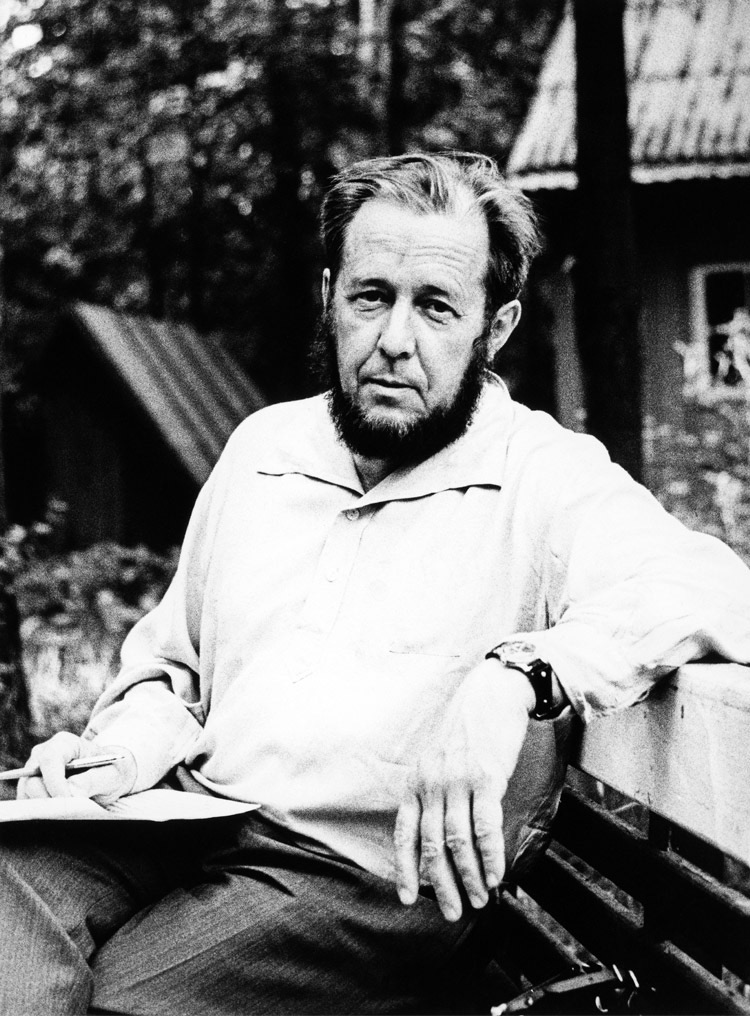
Life in the research prison was not as bad as the Gulag camps, but it was bad enough. Prisoners could see their wives for only a half hour a year, their mail was censored, and their family members on the outside were subject to discrimination.
My favorite characters were Innokenty Volodin, the privileged diplomat who came to understand the horrors of the system, and Spiridon, the simple peasant who ached for his teen-age daughter who was prisoner in a lumber camp. Nerzhin was the character most like Solzhenitsyn.
The profile of Stalin was chilling but also kind of funny. In late night hours, he would enjoy listening to his old speeches. He was a prisoner in his own way to his paranoia and self-absorption.
Among the most tragic of the prisoners was the 1945-46 “stream” of former POWs who were lured back with pamphlets that said, “The Motherland forgives. The Motherland calls.” While America was greeting its POWs with the GI bill, “sturdy Russian prisoners of war [were] exchanging a German stalag for their fatherland’s Gulag.”
The translation was beautiful, with memorable lines and passages throughout. Among my favorites:
If we live in a state of constant fear, can we remain human?
Only sick people alone with their illness (and not in a hospital!) could live an untroubled life in the Soviet Union.
They came back [from the front] cleansed by the proximity of death.
Must love for your native land extend to any and every government it may have? Must you go on abetting it in destroying its own people?
Where should you start reforming the world? With other people? Or with yourself?
Two prisoners debating whether mankind has progressed: “Well, we aren’t burning one another at the stake anymore.” “Why bother with firewood when you’ve got gas chambers?”
Yes, [Volodin] had enjoyed so many blessings! But the most precious of blessings had never been his: the freedom to say what you think, the freedom to associate openly with your intellectual equals.
The Gulag is a country in which a grown man working twelve hours a day cannot earn enough to feed himself.
[For a discussion of the book and Solzhenitsyn’s broader significance, I highly recommend this Econtalk podcast with host Russ Roberts and Russian literature professor Kevin McKenna of the University of Vermont. On another episode, Roberts discusses Solzhenitsyn’s work with historian Stephen Kotkin of Princeton University.]
***
Cancer Ward is a story based on Solzhenitsyn’s real-life experience of nearly dying from the disease when he was living in exile in central Asia in 1953-54. By then he had escaped the hell of the Gulag to the relative “freedom” of life as an ordinary Soviet citizen.
After reading the book, I can confirm my friend’s assessment: Some of the most memorable passages are when the author describes the chronic pain of the patients in the ward. One leans his head over the edge of the bed all day, unable to do anything but long for the next round of pain relievers. Another struggles to turn his head because of the size of the tumor growing on his neck.
The main character in the book, Oleg, lives a simple life in the cancer ward, but he can be grateful that he is no longer in the Gulag:
there were other joys, sufficient in themselves, which he had not forgotten how to value: the right to move about without waiting for an order; the right to be alone; the right to gaze at stars that were not blinded by prison-camp searchlights; the right to put the light out at night and sleep in the dark; the right to put letters in a letterbox; the right to rest on Sunday; the right to bathe in the river. Yes, there were many, many more rights like these. And among them was the right to talk to women. His recovery was giving him back all these countless, wonderful rights.
Another theme of Cancer Ward is contentment. As the author writes: “It is not our level of prosperity that makes for happiness but the kinship of heart to heart and the way we look at the world. Both attitudes lie within our power, so that a man is happy so long as he chooses to be happy, and no one can stop him.”
In passing Solzhenitsyn reflects on the Soviet health system compared to a private system where people pay at least something toward their care. When one character exults that it is one of the greatest achievements of the Soviet system that health care is a free service, another responds:
Is this in fact such a great achievement? What does ‘free’ mean? The doctors don’t work for nothing, you know. It only means that they’re paid out of the national budget and the budget is supported by patients. It isn’t free treatment, it’s depersonalized treatment. If a patient kept the money that pays for his treatments, he would have turned the ten roubles he has to spend at the doctor’s over and over in his hands. He could go to the doctor five times over if he really needed to.
Later the character reflects, “Well, out there, out there in the camps, we used to argue that there was a lot of good in private enterprise. It makes life easier, you see. You can always get everything. You know where to find things.”
And finally, even though the book takes place outside the Gulag, the labor camp system casts a shadow over those who suffered under it:
The icy world which had shaped Oleg’s soul had no room for “unpremeditated kindness.” He had simply forgotten that such a thing existed.
The Uzbeks and the Kara-Kalpaks had no difficulty in recognizing their own people in the clinic, nor did those who had once lived in the shadow of barbed wire.
A man dies from a tumor, so how can a country survive with growths like labor camps and exiles?
I hope these passages and my reflections will spur more people to read Solzhenitsyn’s work. We cannot fully understand the world we live in, or our own human hearts, without at least a basic knowledge of the horrors that took place on a grand scale in the 20th century, and those taking place on a smaller scale today.

 Daniel Griswold's Blog
One thought on “Book notes: Cancer Ward, In the First Circle, and The Gulag Archipelago (abridged), by Alexander Solzhenitsyn”